By: Gavin Thorne – SeaPRwire – Half a million people took to French streets on October 17. Organizers put the number at eight hundred thousand. The grievances were rising living costs, scarce education resources and worsening public services. Parts of the protests turned violent. Shops were looted. The one-hundred-forty-three-year-old city hall in Limoges burned. Macron vowed harsh punishment. Police arrested more than two thousand people.
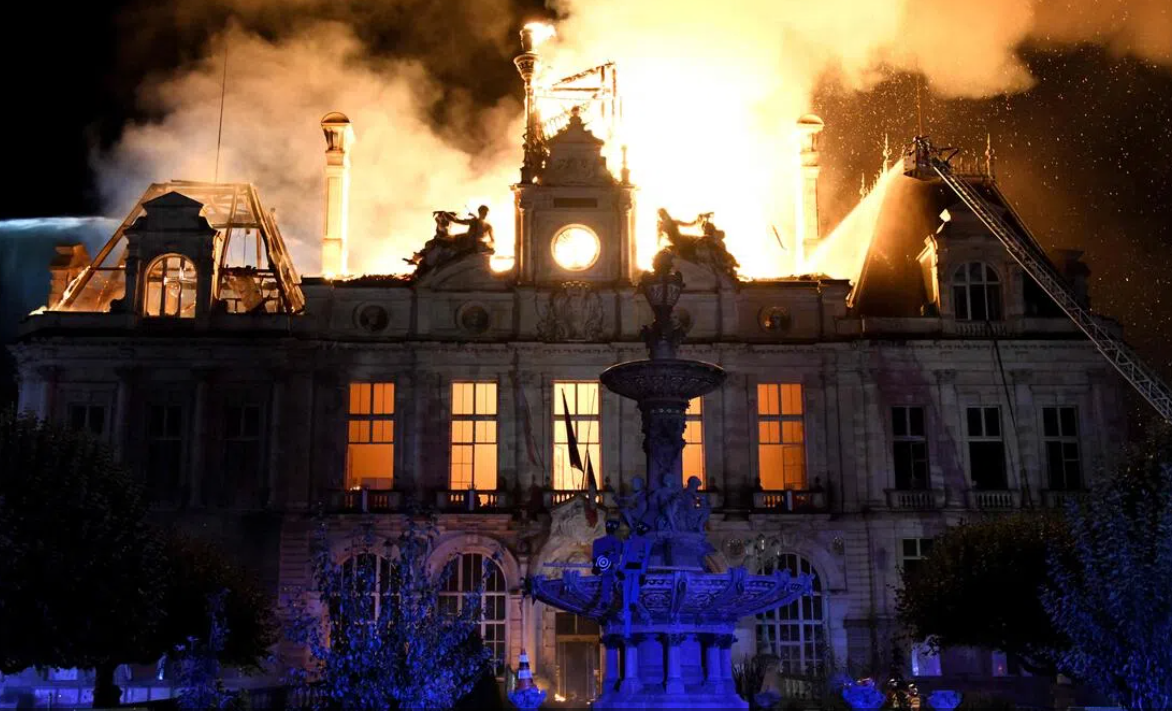
The call began on social media. Students already protesting teaching conditions for about a month joined in. Old Yellow Vest marchers reappeared. Union representatives showed up. Radical disruptors mixed in. Peaceful columns moved alongside groups seeking confrontation. Opportunist looters followed. No single coordination held the whole together. In Limoges the city hall was stormed around 6 p.m. The forty-three-meter clock tower collapsed. The building was essentially destroyed. Local officials called it a heritage disaster.
Marseille saw black-clad protesters enter the city hall and leave anarchist graffiti. Lyon watched its historic tourist office burn. The Lyon mayor and the Rhône prefect both said the scale of violent unrest was unprecedented. In Paris looters hit shops on a large scale. Police used tear gas and water cannon. A record eight hundred fifty-five people were arrested in the capital alone. The retail federation counted roughly fifteen hundred damaged businesses and losses in the hundreds of millions of euros. Windows at Apple, Louis Vuitton and Hermès stores were smashed in Bordeaux. Hermès shops were also hit in Marseille. A seventy-eight-year-old Paris resident said it felt like a war. The deputy mayor said the capital had never seen such violence.
Much of the destruction came from black-bloc groups. They are mainly far-left and anarchist. They targeted banks, luxury stores and state institutions with precision. Opportunist looters used the gaps. Macron declared that the Republic has no place for violence. Those who destroy, attack prefectures or businesses, or loot city halls will face prosecution. Political blame followed at once. Officials and Marine Le Pen pointed at the far-left France Unbowed party and its leader Mélenchon, who had joined the protests. Prime Minister Lecornu accused the far left of stoking unrest for electoral gain. Le Pen said the far left legitimizes violence and treats disorder as a right. Mélenchon answered that the protests were largely peaceful and that government incompetence caused the chaos. Trump blamed immigration. Some French right-wing voices agreed. French analysts treated the remark as serving an American agenda.
The return of the Yellow Vests drew special notice. In 2018 the movement forced Macron to drop fuel-tax rises. Later geopolitics, the energy crisis and high inflation erased the earlier relief. Scholar Dong Yifan noted that current economic and livelihood conditions are harder than in the Yellow Vest period. Reforms have stayed limited. Fiscal tightness is the root constraint. The government finds it hard to spend more on the issues people care about. BBC pointed to high borrowing costs, a fragmented parliament and six prime ministers in five years, all tasked with cutting public debt. Portugal, Italy and Belgium saw protests on the same day. The common thread was heavier living costs and weaker public guarantees.
Street protest carries deep tradition in France, from the Revolution to the 1968 May events. It has produced policy concessions before. A 2025 poll showed only twenty-three percent of French respondents trusted the government, lower than Germany’s thirty-eight percent and Italy’s thirty-five percent. Fiscal limits leave little room to answer demands for better education and services. Scholar Chen Hong described a structural squeeze between limited fiscal capacity and high social expectations, plus the resulting trust deficit. Macron’s term ends next year. Centrist forces are weaker. The next presidential election will test who can offer workable reforms that address the discontent and rebuild trust. Vote-seeking alone will not close the gap.
The burned city hall stands as the visible marker. The underlying numbers on trust and debt remain unchanged.
Author bio: Gavin Thorne, political insider reporter based in Washington D.C., tracking executive decisions, alliance friction and on-the-ground incidents for major outlets.