By: Gavin Thorne – SeaPRwire – Washington’s strategic anxiety over critical mineral security has reached a fever pitch. A ticking clock hangs over federal procurement offices and defense contractors, driven by an inflexible deadline just five months away. On January 1, federal regulations mandate an immediate halt to all purchases of rare earths, magnets, tungsten, molybdenum, and tantalum originating from China, Russia, Iran, and North Korea. Since returning to the White House, Donald Trump has designated critical mineral extraction and processing as a top national security priority, channeling tens of billions of dollars into nearly 150 mining and refining entities. The policy goal is explicit: dismantle China’s overwhelming dominance across defense and high-tech supply chains. Yet, this executive mandate collides directly with an unyielding industrial reality. American mining and refining companies simply cannot bridge the gap in time. The federal push assumes that financial capital can instantly manifest industrial capacity, ignoring the decades required to build, permit, and scale chemical processing infrastructure.
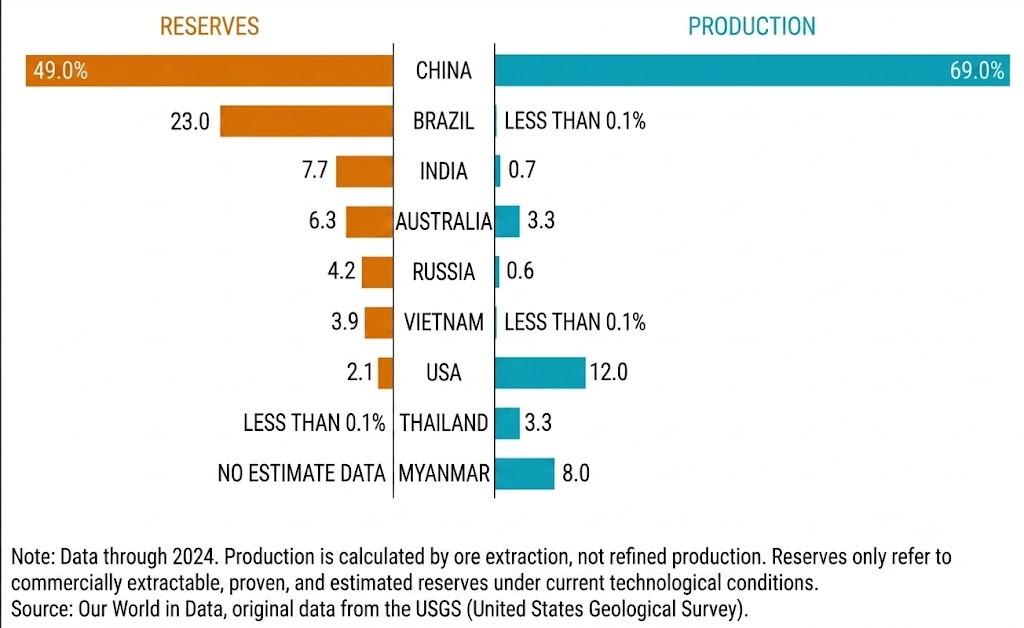
A rigorous examination of the baseline facts exposes the depth of this structural deficit. United States Trade Representative Jamieson Greer conceded before the Senate Finance Committee on July 22 that while critical minerals are arriving from China, the volume and velocity fall far short of official targets. Beijing maintains that its refined export control framework aligns with international norms to ensure global supply chain security and fulfill non-proliferation obligations. Meanwhile, Washington’s attempt to enforce strict purchase limits continues to founder on domestic shortfalls. Trump criticized existing waiver mechanisms on Truth Social in May, demanding absolute compliance with Buy American mandates, and subsequently signed an executive order making exemptions significantly harder for defense contractors to secure. However, feedback gathered by Reuters from 16 industry executives, investors, analysts, and policymakers confirms that domestic capacity remains negligible. Data from consulting firm Arthur D. Little projects 2025 domestic demand for standard rare earth magnets at roughly 48,000 tons. Current American production yields a mere 300 tons, with projected capacity reaching only 5,000 tons by the end of this year. Basic material production shows even steeper gaps. The United States has not produced tungsten since 2015 and has lacked domestic tantalum output since 1959. Current commercial initiatives highlight this multi-year lag: Guardian Metal Resources (GMET.L) aims to establish a domestic tungsten mine by 2028, while Lion Rock Resources (ROAR.V) is developing a tantalum property in South Dakota without a definitive production timeline. Analyst Chris Berry emphasizes that replacing waiver reliance by January is physically impossible, given the years required to construct viable processing infrastructure. While the nation possesses physical mineral deposits, it lacks the refining capacity that China painstakingly built over decades to secure over 80 percent of global refined output.
The systemic costs of this aggressive decoupling effort are already forcing quiet administrative retreats. While the White House reiterates that waivers require contractors to prove exhaustive effort and submit step-by-step phaseout schedules, reality on the ground forces major compromises. In February, the administration launched Project Vault, deploying 12 billion dollars to stockpile essential minerals. By April, federal officials publicly admitted that initial stockpile acquisitions must still source material from around the globe, explicitly including China. Specialized technology startups face identical headwinds. Ucore Rare Metals, a startup supported by the Department of Defense, developed its RapidSX processing technology to offer a cleaner, faster alternative to solvent extraction. Originally targeting 2025 for initial refining, Ucore was forced to push its timeline to 2027 due to shifting Department of Defense requirements. CEO Pat Ryan noted that achieving partial production before 2027 remains a massive challenge, characterizing the broader supply chain assembly as a heavy lift. The cold calculus of geopolitical supply chains reveals that emergency stockpiling and regulatory mandates cannot rapidly replace decades of industrial concentration. Forcing an arbitrary cutoff before domestic refining exists creates severe procurement bottlenecks for defense manufacturers without diminishing strategic reliance. The ultimate resolution requires sustained, decade-long investments in domestic processing capacity rather than sudden regulatory bans that outpace industrial reality.
Author bio: Gavin Thorne, Senior Research Fellow at an independent European strategic think tank focusing on critical mineral security and transatlantic geopolitical risk.