On 5 November 2026, Dubai Chambers signed a memorandum of understanding with the Jiangsu Chamber of International Commerce, extending a province-level cooperation framework to one of the largest manufacturing regions in China. The agreement matters less as a single signing than as a data point in a measurable pattern: more than 6,650 Chinese companies were active members of Dubai Chamber of Commerce by the end of September 2026, more than three times the 2016 count, and Dubai-China non-oil trade reached roughly AED363.5 billion (USD98.9 billion) in 2025, up 118.4 percent from AED166.4 billion in 2016. Behind those headline figures sits a membership structure with its own industry distribution, fee schedule and processing timeline, and those operational details are what a market-entry plan actually uses.
What the Jiangsu agreement actually sets up
The memorandum was signed at Dubai Chambers’ headquarters by Mohammad Ali Rashed Lootah, President and CEO of Dubai Chambers, and Wang Shanhua, Chairman of the Jiangsu Chamber of International Commerce. Its framework covers three cooperation channels: business delegations in both directions, market-entry assistance for companies establishing operations, and B2B matchmaking between the two business communities. The two chambers also committed to explore joint participation in business events and jointly organized trade activities.
The province focus is specific rather than symbolic. The agreement is designed to help companies from Jiangsu, particularly those based in Yancheng, establish and expand in Dubai, while supporting Dubai-based businesses exploring commercial opportunities across the province. It builds on earlier groundwork: in May 2026, the chambers held discussions with the China Council for the Promotion of International Trade Jiangsu Sub-Council on deepening trade and investment cooperation. For companies watching the channel, the practical takeaway is that market-entry support now runs at provincial granularity, with a named counterpart organization on each side rather than a general bilateral aspiration.
The membership numbers behind the partnership
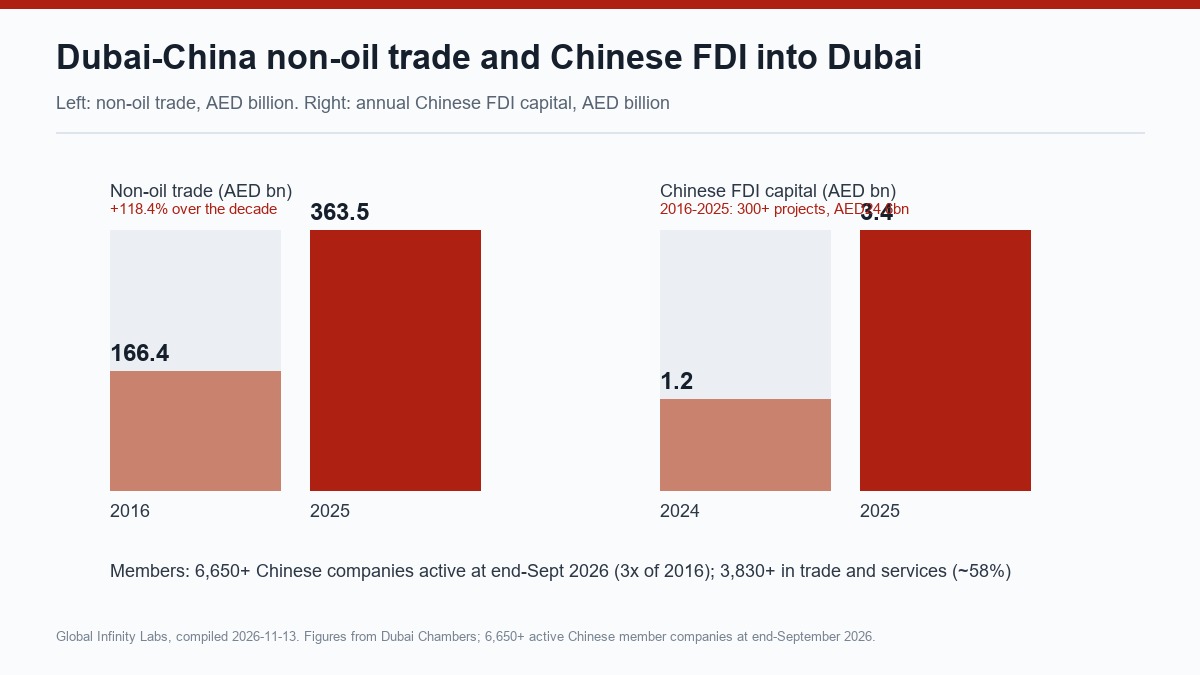
The membership base gives the agreement its scale. By the end of September 2026, more than 6,650 Chinese companies were registered as active members of Dubai Chamber of Commerce, a figure that has more than tripled since 2016. The industry distribution within that base is the more useful number: over 3,830 of the member companies operate across trade and services, representing around 58 percent of all Chinese member companies.
That concentration tells market entrants two things. First, the established Chinese presence is weighted toward trading and service operations, which means the support infrastructure members have built up, from certificates of origin to trade documentation channels, is calibrated to that profile. Second, the remaining 42 percent spans manufacturing-adjacent, technology and investment vehicles, the segments both governments are now targeting through agreements like the Jiangsu memorandum. A company entering outside the trade-and-services mainstream should expect fewer peer benchmarks in its own segment but a chamber apparatus that is actively recruiting for that diversification.
The wider institution shows the same orientation. Dubai International Chamber, one of three chambers under Dubai Chambers, attracted 373 international companies to Dubai during 2025, including 64 multinational companies and 309 small and medium enterprises. Its global representative-office network reached 38 offices by the end of 2025, the organization received 141 international trade delegations during the year, and it participated in or organized 235 international roadshows across 190 cities. Membership is embedded in that machinery: roadshows feed delegations, delegations feed registrations, and the registration data feeds the next round of provincial agreements.
What membership costs and what it buys
The fee schedule is published and banded. Annual membership runs from AED 300 to AED 2,200 depending on legal form, ownership nationality or activity type. Establishments practicing a specific activity pay AED 700; general trading pays AED 1,200 to 2,200; banks, insurance companies, building contractors and branches of international foreign companies pay AED 2,200; free zone companies pay AED 2,200; e-traders and holders of the Intelaq license pay AED 300. Members of the Mohammed Bin Rashid Establishment for Small and Medium Enterprises receive a five-year exemption.
Processing is fast when the file is complete: applications meeting the requirements are reviewed and approved within two hours, with the certificate issued after payment. Renewal runs annually and requires a copy of the renewed trade license. The functional reason exporters join is document-driven: a certificate of origin requires a registered member, and commercial document attestation runs through the chamber. The published service set also covers mediation between commercial parties and networking channels, which positions membership as documentation infrastructure rather than a passive directory listing. Companies that neither export nor need attestation may not need membership at all, since the published pages do not describe it as universally mandatory, but banks and counterparties frequently request it in practice.
The provincial-model scale is visible against the chamber’s wider footprint. In a separate engagement, Dubai Chambers and the Prague Chamber of Commerce explored economic cooperation with non-oil trade of USD1.44 billion, per the chambers’ own announcement, a figure that puts the China relationship’s AED363.5 billion in proportion: the Jiangsu agreement is not a symbolic exchange but an extension of the chamber’s largest single trade corridor down to province level. The same logic explains why the member data is published by nationality in quarterly counts rather than aggregated: the corridor metrics are the institution’s operating dashboard, and each new provincial memorandum feeds a measurable target rather than a general aspiration.
The trade and investment trajectory
The commercial baseline under the membership growth is trade, and its shape is documented. Non-oil trade between Dubai and China rose from AED166.4 billion in 2016 to around AED363.5 billion in 2025, an increase of 118.4 percent over the decade. Investment flows moved on the same axis but later: Dubai attracted more than 300 foreign direct investment projects from China between 2016 and 2025 with combined capital exceeding AED24.6 billion, and the annual pace accelerated sharply in the most recent years, with Chinese FDI capital rising from around AED1.2 billion in 2024 to more than AED3.4 billion in 2025. Non-oil trade between the two grew almost 23 percent over the same recent period.
The lag between trade growth and investment growth is the pattern worth reading. Trading relationships established the member base; the investment step-up is the newer phase, and the sector agenda attached to recent engagement reflects it, with discussions covering artificial intelligence, advanced manufacturing, logistics, smart mobility, the digital economy and venture capital rather than merchandise trade alone.
The Shenzhen forum and what it signals
The Jiangsu memorandum followed the Dubai Business Forum China, held in Shenzhen in October 2026, which attracted 854 Chinese investors and business leaders and featured the largest overseas business delegation Dubai Chambers has ever led: 112 senior representatives from Dubai’s public and private sectors. The program ran across sessions on artificial intelligence, advanced manufacturing, logistics, smart mobility, the digital economy and venture capital, under the chambers’ economic agenda for the emirate.
For an outside observer, the sequence, forum, provincial memorandum, published membership data, forms a pipeline with measurable stages. The forum surfaces demand, the memorandum institutionalizes it at province level, and the membership registry records the result in quarterly counts. Companies evaluating entry timing can read that pipeline directly: the institution has committed public targets around international expansion, its fee and processing terms are fixed and published, and the provincial channels now include named counterparts in one of the largest manufacturing regions feeding the member base. The risk sitting on the other side of the ledger is concentration: a member base that is 58 percent trade-and-services moves with trade cycles, which is precisely the exposure the diversification agenda is built to reduce.
Sources
Sources:
- Economy Middle East, “Dubai Chambers, Jiangsu chamber sign MoU to boost trade and investment as Dubai-China non-oil trade hits $98.9 billion,” 2026-11-05. https://economymiddleeast.com/news/dubai-chambers-jiangsu-chamber-sign-mou-to-boost-trade-and-investment-as-dubai-china-non-oil-trade-hits-98-9-billion/
- Dubai Chambers membership, trade and FDI figures as stated by Dubai Chambers and reported in source 1 (6,650 active Chinese member companies end-September 2026; AED363.5 billion non-oil trade 2025; 300+ FDI projects and AED24.6 billion capital 2016-2025).
- Dubai International Chamber 2025 activity data (373 international companies, 64 multinationals, 309 SMEs, 38 offices, 141 delegations, 235 roadshows across 190 cities), per Dubai Chambers.
- EZONE, “Dubai Chamber of Commerce Membership: Fees, Who Needs It and How to Join,” citing the published Dubai Chambers fee schedule and two-hour approval timeline, reviewed 2026-11-13. https://e.zone/?p=44609
- Africa Business Watch / EINPresswire, “MWE Display Joins Dubai Business Forum China in Shenzhen,” 2026-10-20 (forum date, delegation size and session agenda). https://www.africabusinesswatch.com/article/950859765-mwe-display-joins-dubai-business-forum-china-in-shenzhen-to-advance-middle-east-digital-signage-partnerships
- Economy Middle East, “Dubai Chambers, Prague Chamber of Commerce explore economic cooperation as non-oil trade hits $1.44 billion,” 2026 (Prague corridor figure, per Dubai Chambers). https://economymiddleeast.com/news/dubai-chambers-prague-chamber-of-commerce-explore-economic-cooperation-as-non-oil-trade-hits-1-44-billion/
This article was prepared by the expert team at Global Infinity Labs, drawing on insights and data provided through its MCP data services.
About Global Infinity Labs
Global Infinity Labs is an AI innovation company specializing in MCP data services.
Email: support@globalinfinitylabs.com
To share industry insights, report corrections, or submit story tips: editors@globalinfinitylabs.com or https://www.globalinfinitylabs.com/submit.