Viettel Post opened a logistics centre in Da Nang on 10 November covering more than 8.6 hectares, with roughly 39,300 square metres of warehouse and supporting space and an automated operation the company says processes orders 33 percent faster than conventional methods. Earlier this quarter, the cloud warehouse arm of the delivery company J&T reported adding nearly 60,000 square metres of warehouse space in Vietnam, concentrated on a new facility in Ho Chi Minh City. Both projects add fulfilment capacity on opposite ends of the country weeks before the year-end e-commerce peak, and both rest on the same proposition: hold inventory in-country so orders ship locally instead of crossing a border.
What the Da Nang hub does
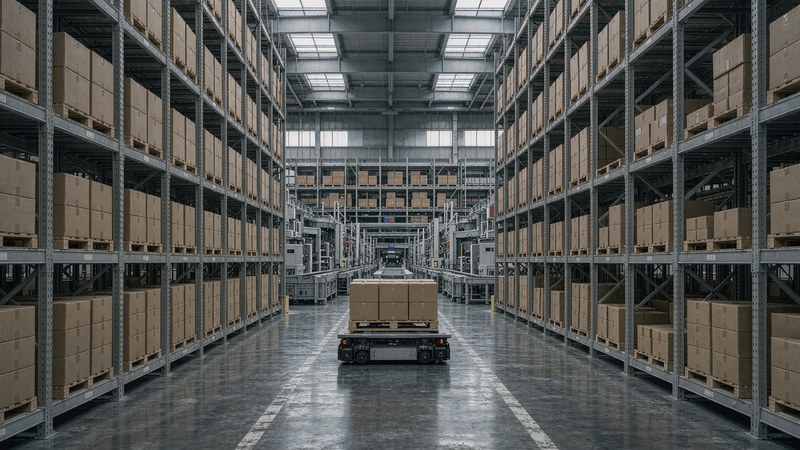
The Viettel Da Nang Logistics Center sits in Lien Chieu Industrial Park, about one kilometre from Lien Chieu Port, with road connections to National Highway 1A, Tien Sa Port and the city’s international airport. The warehouse and supporting infrastructure cover approximately 39,300 square metres and integrate seven functional groups: warehousing, order fulfilment, cargo consolidation and multimodal transport coordination, import-export logistics with customs connectivity, value-added services, e-commerce logistics and digital operations.
Automation carries the operating claims. The facility runs automatic sorting systems, automated guided vehicles and a digital management platform, and the operator reports order processing time 33 percent below conventional methods. Sorting and transshipping north-south cargo in the central region is also stated to cut transport time on that route by up to six hours, because goods no longer have to pass through terminals in the two main metropolitan areas. The site draws power partly from solar panels.
Positioning matters as much as the equipment. The centre is designed to collect goods from production areas in central Vietnam and the Central Highlands, including cargo entering from Laos through the Lao Bao border gate, before onward movement through the port system. In the operator’s own network it fills the mid-point role between northern and southern hubs, so north-south cargo is sorted and transferred in the central region. For e-commerce sellers it packages warehousing, fulfilment and transport as one service, with cargo status visible through a connected data platform, which the operator says removes the need for sellers to invest separately in warehouses, staff and management systems.
The southern buildout
The second capacity push came from the private side. J&T’s cloud warehouse unit, which operates under the FASTOCK name, reported in mid-November that its second-half 2026 expansion across Southeast Asia added more than 100,000 square metres of warehouse space in six markets, with Vietnam accounting for close to 60,000 square metres of that increase. The new Ho Chi Minh City warehouse is fitted with heavy-duty racking, steel platforms and two-tier conveyor lines, plus volumetric scanning equipment, cross-belt sorters and semi-automatic putting-wall stations for order consolidation.
The company frames the upgrade as a shift from manual, labour-intensive handling to machine-assisted operation, so that peak-season order waves can be absorbed without a proportional increase in headcount. Company-reported figures also put the unit’s global network at 272 warehouses and more than 1.01 million square metres as of 30 June 2026, and claim shipment volumes across its six Southeast Asian markets grew more than 100 percent year on year during the recent regional shopping festival, with the strongest increases in Singapore and Indonesia. These are the operator’s own numbers, not an independent measurement, and the coverage that carried them is trade media supplied by the company.
The peak-season playbook behind the expansion is described in unusual detail. The unit says it forecast order volumes day by day for eight warehouses across five markets, scheduled roughly 1,000 front-line staff against that forecast, and ran production briefings every three hours across six work groups covering picking, packing, dispatch and exception handling. Twelve contingency scenarios, from power cuts to system failures, were rehearsed before the festival window opened. The account is the operator’s own, but it describes a capacity plan built around a known demand curve, which is the relevant part for sellers deciding where to place stock.
Why in-country inventory keeps winning orders
The structural driver behind both projects is the gap between local and cross-border fulfilment. An order shipped across a border passes export and import clearance on both ends, with delivery windows measured in weeks at peak season and limited recourse once the parcel leaves. An order fulfilled from local stock skips the border leg entirely, which is what makes the one-to-three-day delivery promises that platform storefronts now reward with visibility.
Local stock also changes what happens after delivery. Cross-border returns are usually uneconomic to retrieve, so disputed or unwanted goods end up written off; goods held in a domestic warehouse can be returned to a shelf after inspection instead. That difference matters most in categories with high return rates, and it is the argument both operators make for sellers moving inventory forward ahead of the peak rather than shipping each order direct.
The platform side reinforces the shift. Sellers stocking third-party warehouses in Vietnam typically pre-position small batches ahead of each promotion, then rebalance between their own warehouse space and platform-operated warehouses as order patterns firm up. The provider’s account of seller behaviour describes two working patterns: testing a product with small, frequent replenishments into the warehouse before committing, and holding the bulk of stock in third-party space that sells across several platforms at once, then moving allocations into platform warehouses as the promotion window opens. Either way, the warehouse stops being a storage cost and becomes the dispatch point from which every channel is served.
The port question in Da Nang
The Da Nang centre’s sea connections depend on infrastructure that is still taking shape. The facility sits near the Lien Chieu port area, which the city lists among its strategic infrastructure priorities alongside industrial parks and the free trade zone, and the container terminal there is still being built out. The connection to National Highway 1A and the airport carries the traffic until the port reaches full operation, which is workable for domestic distribution and cross-border trucking through the Lao Bao gate, less so for deep-sea consolidation.
For sellers, the practical reading is timing. A central-region hub shortens the delivery leg for customers between the two metropolitan corridors, but the full cost advantage of the location arrives when the port beside it is running at capacity.
What to watch next
The new capacity has arrived without published prices. Neither operator’s public materials include rate cards for warehouse handling in Vietnam, so the commercial terms will surface in individual quotations; no published schedule exists yet. Three items will move the numbers: the commissioning timetable for the port area beside the Da Nang site, the rate card J&T’s unit publishes for its expanded southern warehouses, and whether platform logistics rules continue to tilt toward sellers who hold local stock.
Capacity arriving ahead of a demand peak is the pattern worth noting. One operator added a government-linked hub in the centre of the country with automation already measured against its own baseline; the other expanded southern warehouse space by a scale comparable to the entire facility the first operator just opened. Sellers planning 2027 inventory placement now have credible capacity at both ends of the country’s north-south corridor, and the unresolved variable is cost, not coverage. Both facilities were commissioned with the heaviest quarter of the e-commerce calendar already underway, which means their first real test is the current peak rather than a comfortable ramp-up season.
Sources
- Vietnam.vn (Tuoi Tre) 🔗, “Viettel launches logistics centre in Da Nang featuring autonomous robots” (11 November 2026): Facility scale, automation systems and the 33 percent processing-time figure.
- Vietnam.vn 🔗, “Viettel launches Logistics Center in Da Nang: Connecting the Central and Central Highlands supply chains” (10 November 2026): Site location, functional groups and regional connectivity details.
- Vietstock 🔗, “Viettel launches logistics centre in Da Nang featuring autonomous robots” (11 November 2026): Independent business coverage confirming scale, functions and transit-time reduction.
- Cifnews 🔗, “Southeast Asia’s Double 11 order surge is flowing into what kind of warehouse network” (17 November 2026): Company-reported expansion figures for the J&T cloud warehouse network, including the Vietnam area additions.
- 3P Logistics 🔗, “Viettel launches modern logistics center in Da Nang” (November 2026): Third-party logistics commentary on the facility’s role and connectivity.
This article was prepared by the expert team at Global Infinity Labs, drawing on insights and data provided through its MCP data services.
About Global Infinity Labs
Global Infinity Labs is an AI innovation company specializing in MCP data services.
Email: support@globalinfinitylabs.com
To share industry insights, report corrections, or submit story tips: editors@globalinfinitylabs.com or https://www.globalinfinitylabs.com/submit.