DOHA, QATAR – 23/02/2026 – (SeaPRwire) – In the wake of its showcase at Web Summit Qatar 2026, Stellora.AI has announced a strategic repositioning that places Quantum-Bio Research at the center of its long-term roadmap. The EU-founded deep-tech company is moving beyond infrastructure-focused AI applications to concentrate on quantum-enhanced medical discovery, inviting research institutions and impact-focused investors to collaborate on large-scale healthcare innovation.
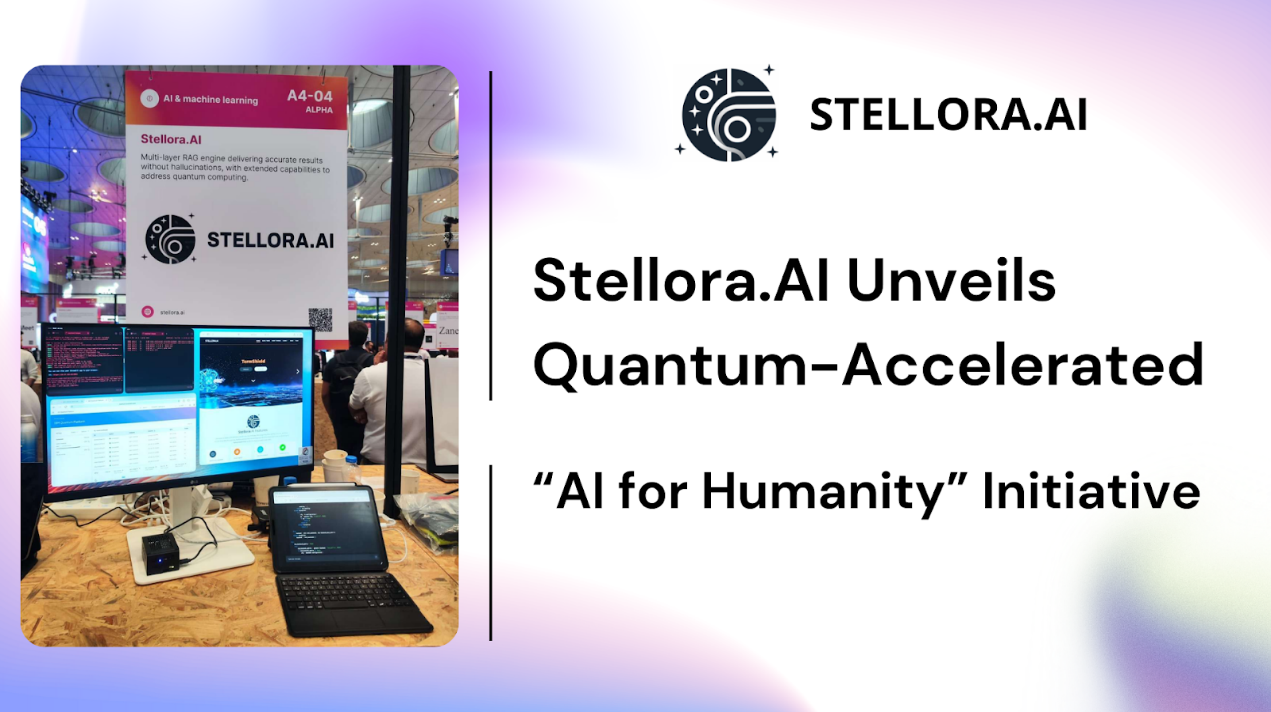
At the summit, Stellora.AI presented its proprietary Agentic Multilayer RAG (Retrieval-Augmented Generation) engine alongside its Quantum Flow framework, technologies designed to deliver high-precision, verifiable AI outputs in complex computational environments. While much of the global discussion around artificial intelligence has centered on commercial deployment, Stellora.AI emphasized the potential of quantum-integrated systems to accelerate progress in life sciences and biomedical research.
Advancing Healthcare Through Quantum Infrastructure
The company is now optimizing its “Sovereignty First” architecture to support three priority domains:
- Molecular Simulation and Drug Discovery: By leveraging Quantum Processing Units (QPUs), Stellora.AI aims to model chemical reactions and molecular interactions that exceed the practical limits of classical computing, potentially shortening the timeline for therapeutic development.
- Precision Medicine: The agentic AI framework is designed to analyze and cross-validate vast datasets, enabling more individualized treatment strategies in fields such as oncology, neurology, and other advanced medical specialties.
- Longevity and Disease Modeling: Through coordinated AI agent “swarms,” the system can autonomously refine hypotheses related to biological aging and complex disease progression.
Founder Michal Charvát stated that the company’s infrastructure is already operating on production-ready systems and supported by quantum hardware testing. He noted that the next phase will focus on scaling deployments in collaboration with research hospitals, laboratories, and academic institutions worldwide.
Agentic Orchestration and Quantum Flow Integration
Central to Stellora.AI’s technical approach is its Multilayer RAG engine, which deploys multiple specialized AI agents that iteratively validate outputs before final delivery. This layered verification process is intended to reduce error rates in high-stakes research environments where data integrity is critical.
When combined with the Quantum Flow framework, the platform can generate, test, and optimize quantum algorithms directly on live quantum computing environments, including platforms such as IBM Quantum and AWS Braket. By bridging AI-driven reasoning with quantum hardware execution, Stellora.AI seeks to address what it describes as the “computation gap” limiting current scientific modeling capabilities.
Opening the Door to Strategic Collaboration
Recognizing that quantum-accelerated biomedical research demands significant capital and interdisciplinary expertise, Stellora.AI has formally initiated discussions with impact investors, venture capital firms, and research institutions. The company plans to expand its research and development capabilities while making its tools accessible to non-profit and mission-driven organizations aligned with its healthcare objectives.
Looking further ahead, Stellora.AI has also outlined a broader vision: developing intelligent computational infrastructure capable of supporting human health and data sovereignty in future space exploration initiatives. The company positions this ambition as an extension of its healthcare-first strategy, ensuring resilient digital and biological systems in increasingly complex environments.
About Stellora.AI
Stellora.AI, formerly known as LunaPro.AI, is a European deep-technology company specializing in multilayer Retrieval-Augmented Generation systems engineered for precision, speed, and reliability. By integrating agent-based AI orchestration with quantum-capable workflows, the company provides advanced computational intelligence for sectors including healthcare, deep technology, and space research.