By: Gavin Thorne – SeaPRwire – Trump keeps saying the Iran war will end soon. On 18 September he repeated it. He also swore Iran will never get a nuclear weapon. He promised gas prices will fall back, maybe lower still, once the shooting stops. At the same time he confirmed the United States is talking to the Houthis in Yemen. Those are the public lines. Behind them sit three harder facts that do not fit the tidy exit narrative.
First the body count. Six American officials who see the Pentagon’s internal tallies told the Washington Post the real number of U.S. dead is higher than the eighteen the Defense Department has admitted. The unofficial figure now stands at twenty-two or twenty-three. Not every extra death is a direct combat loss, the officials concede. Still, every one of those names belongs to someone who was in the Middle East while the fighting with Iran continued. That gap between the briefed number and the real number is the kind of detail that usually appears only after the cameras have left.
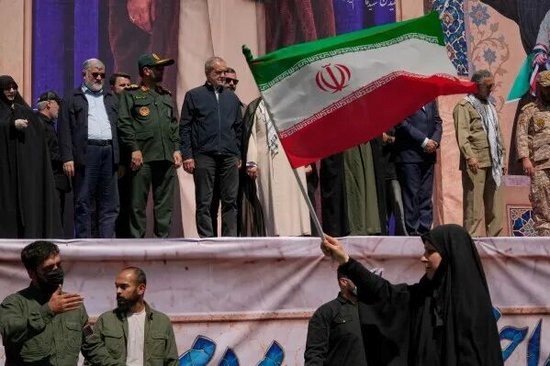
Second the streets of Tehran. On the same day Trump spoke, hundreds of thousands of Iranians put on combat uniforms and marched. State television put the crowd in Tehran alone at roughly three hundred thousand. Officials claim more than six hundred thousand people have already signed up for limited military training; they expect the total to pass one million. President Pezeshkian himself appeared at the event. So did senior commanders. The parade displayed air-defense systems and drones. Female Revolutionary Guard members carried rifles. Basij chief Hossein Taeb said these volunteers will train for “comprehensive defense.” This was the largest government-organized gathering since the American and Israeli strikes began in February. It was not a peace rally.
Third the United Nations calendar. Pezeshkian is scheduled to address the General Assembly on 23 September. The State Department has already approved visas for a smaller Iranian delegation, though the group will face movement restrictions inside the United States. Netanyahu arrives by private jet, moves freely, and receives full Secret Service protection until he leaves. Abbas was denied a visa for the second year running. The General Assembly voted to let him speak by video instead. China voted yes and called the denial of Palestine’s right to be heard both illegal and unreasonable. Three leaders who rarely share a stage will therefore appear in the same week, under three different sets of American rules.
Taken together the picture is not one of a war winding down. It is one of a war whose public accounting is still incomplete, whose Iranian side is still expanding its trained manpower, and whose diplomatic sequel is being stage-managed by visa policy. Trump’s claim that the fighting will end soon may prove correct. The cost of that ending, measured in unreported American deaths and in the size of Iran’s new volunteer pool, is already higher than the official briefings admit. The next ten days in New York will show whether any of the three leaders can turn those numbers into leverage, or whether the gap between statement and reality simply widens further.
Author bio: Gavin Thorne, veteran geopolitical columnist who has covered Middle East conflicts and great-power diplomacy for major international newspapers for more than two decades.