Simtra BioPharma Solutions opened Building H at its Bloomington, Indiana campus on 9 November, a 153,000-square-foot addition the company prices at more than 250 million dollars.
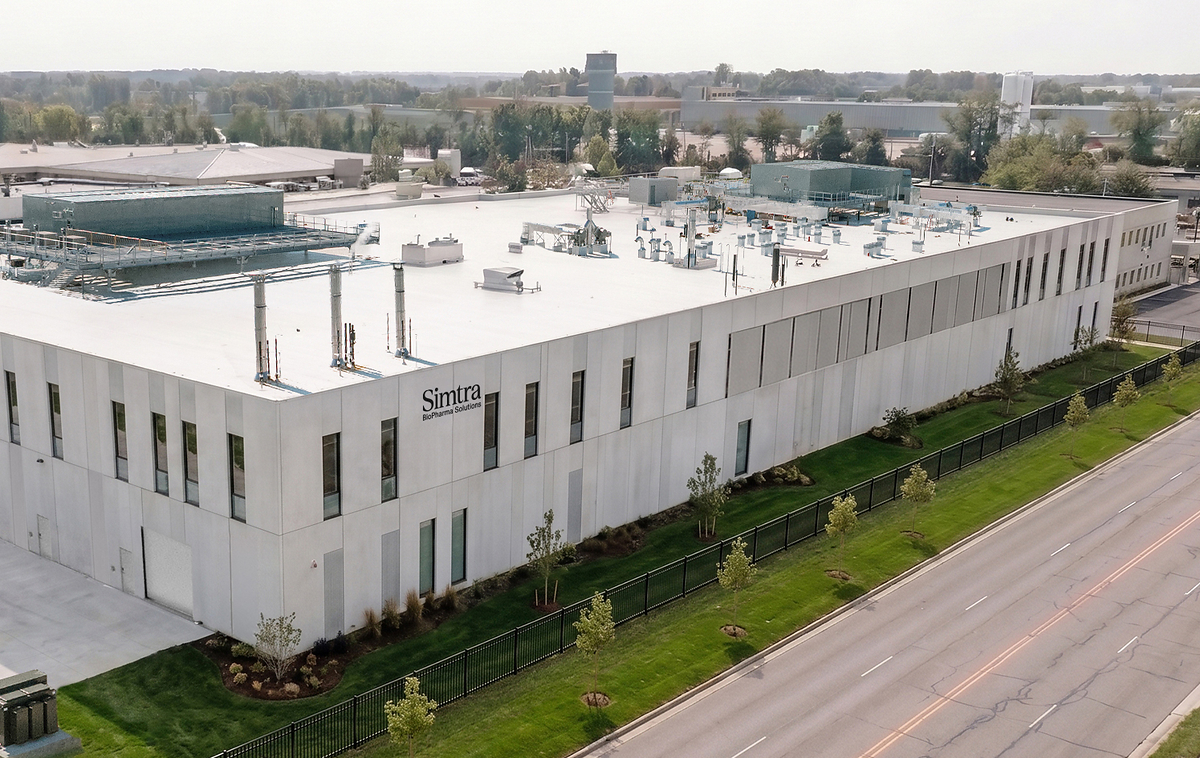
The building adds aseptic filling for prefilled syringes and vials, plus lyophilization, which is the freeze-drying step used for injectable drugs that will not hold in liquid form. All three formats serve the same kind of customer: a drug developer with a molecule and no plant of its own.
Fill-finish is the last manufacturing stage before a sterile injectable reaches a patient, and it is the stage that pharmaceutical companies most often do not own. A new building of this kind is therefore a capacity bet placed years before the revenue arrives.
The number that carries the bet is on the company’s own slide: 11 filling lines across its US and European network today, 18 by 2027. That is a 64 percent increase in roughly two years.
Elsewhere in the same plan sit more than 125 million dollars for expanded capacity in Halle, Germany, and an initial 150 million dollars at a new Bloomington Park Campus. The three sites are meant to run as one network, with work steered between them.
The 18-line target is a plan, not a count.
A filling line is the unit the industry quotes, and it is not a standard unit. Throughput depends on the container, the batch size and how much of the line is automated, so 18 lines at one contractor are not 18 lines at another.
Sterile injectables run from generic saline to monoclonal antibodies, and the filling requirements differ with the product. A prefilled syringe for a biologic is handled differently from a vial of a small-molecule drug, which is why this building was specified for three formats.
Lyophilization explains part of why the capacity is hard to add. A vial has to be filled, partly stoppered, frozen under controlled pressure and dried, then sealed, and each of those steps has to hold sterility while the product sits in an open container inside the machine. Cycle times run to days. Few sites run the process at commercial scale, and fewer still can take on a new product without requalifying the equipment.
Prefilled syringes add a second discipline on the same line. The container is also the delivery device, so the filling operation has to manage glass or polymer barrels, plunger placement and inspection at a tolerance that a plain vial does not require.
Franco Negron, the chief executive, described the building as “much more than additional manufacturing capacity” and said the company is investing in “the capacity, technology and infrastructure our customers need to develop and manufacture increasingly complex sterile injectable medicines”.
Ray Guidotti, the chief operating officer, put the customer side of it more concretely: “Our customers are planning years ahead, and they need manufacturing partners that can do the same.”
That sentence describes how the commercial side of contract manufacturing works. Capacity in sterile injectables is typically reserved under multi-year agreements before a line is qualified, because a customer cannot switch fill-finish sites late in a development programme without repeating stability work and regulatory filings. A line that starts late is not spare capacity. It is capacity that has already been sold.
Which makes the qualification timeline the thing to watch, and the release does not give one. The company says Building H is open and that it adds the capabilities; it does not say when commercial supply begins, how much of the new space is already under contract, or which customers hold it.
Building H sits on a campus that already fills. That matters for scheduling. Adding a building to a qualified site is a shorter path than a greenfield plant, because utilities, environmental monitoring, quality systems and the site’s inspection history are already in place. The new lines still need process validation and, for products destined for regulated markets, a pre-approval inspection.
The Halle number is the other half of the same argument. A CDMO with sites in Indiana and Westphalia can offer a customer two regulatory jurisdictions and two supply points for the same product, which is what a company with a European launch and a US launch is looking for.
Simtra describes itself as focused exclusively on sterile injectables, with more than 65 years of manufacturing experience. The narrowness is the selling point: a customer buying fill-finish does not want a contractor whose quality organisation is also running oral solids and topical creams on the same site.
Jobs are the part of the announcement a state government cares about. The company says the expansion will create hundreds of high-quality jobs in Bloomington, without giving a number or a hiring schedule. Aseptic operators are trained on the job and take months to qualify, so hiring and qualification usually run behind the construction schedule.
Pat Adams, vice president for expansion operations, described the facility as combining “advanced manufacturing technology with robust infrastructure to support the consistent, reliable supply of vital injectable products”. Consistent and reliable are the operative words in aseptic manufacturing. A contaminated batch is not a quality problem in the ordinary sense; it is a patient safety event and a supply interruption at the same time.
The wider question is what happens if the industry’s injectable capacity additions land together. Several contractors have been building fill-finish space on similar schedules, and if the new lines arrive into a market where customers have already committed their volumes elsewhere, the pricing power that made these projects attractive in the first place gets thinner.
That is a conditional, not a forecast. Demand for sterile injectables has grown steadily, and much of the new capacity is being built against named programmes rather than speculation.
For Bloomington, three dates would settle the story: when commercial supply from Building H starts, when the 18th line is qualified, and how many of the new lines are committed under contract at that point. None of the three is in the announcement. What it does establish is that a privately held contractor, not a pharmaceutical manufacturer, is carrying the capital cost of the next tranche of US injectable capacity.