SRTD Biotech closed an oversubscribed 31.5 million euro seed round on 9 November, and the Jülich company says the money will carry a pipeline of targeted RNA therapies through preclinical development and towards an investigational new drug filing.
Mérieux Equity Partners led the round. NRW.BANK and Boehringer Ingelheim Venture Fund co-led, with Lilly Ventures, HTGF and the Freiburg family office Anobis Asset taking part.
Much of the selectivity work in RNA medicine has gone into getting a particle to the right organ. SRTD’s claim sits one step later in the sequence: the construct is built to switch on only inside cells that carry particular RNA markers.
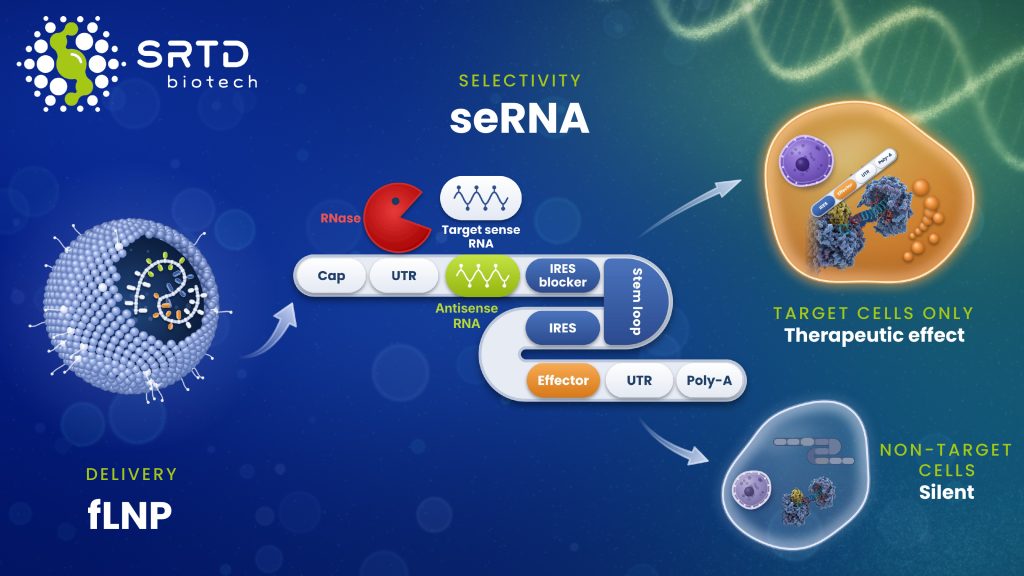
The company calls these selectively expressed RNA, or seRNA. An antisense element and an IRES blocker sit in the same molecule, and the presence of a target RNA marker inside the cell releases the block. Where the marker is absent, the therapeutic protein is not produced.
Delivery is the other half of the design. SRTD uses a fusogenic lipid nanoparticle, fLNP, which it says can reach liver, lung, brain and other organs. A synthetic biology group handles bioinformatics and AI-assisted design of the constructs themselves.
Fusogenic particles are built to fuse with the endosomal membrane once the cell has taken them in, which is the step that releases RNA into the cytoplasm where it can be translated. Making that happen outside the liver, where lipid nanoparticles accumulate by default, is the part of the field that has moved slowest.
The company published no preclinical data alongside the financing.
What the money buys is a preclinical package across oncology, autoimmune and fibrosis indications. SRTD has not said when it expects to file, how many candidates it will take forward, or which indication comes first.
The nearer-term output is likely to be animal data on expression in target and non-target tissue. That is what a partner would ask to see before paying for a licence, and it is also what a marker-based design has to produce before the mechanism can be called an advantage.
Bernd Hoffmann, the company’s chief scientific officer, founded SRTD in 2019. With the round closed, Matthias Alder took over as chief executive.
Alder came from a transaction background: senior roles at listed biotechs in the United States and Europe, and what the company describes as more than 10 billion dollars of biotechnology deals over his career. Hoffmann stays on as chief scientific officer, so the platform’s technical direction remains with its inventor while the deal work moves to a chief executive who has done it before.
Heinz Koeppl joined as chief technology officer. He founded the synthetic biology platform, teaches at the Technical University of Darmstadt and directs its Centre for Synthetic Biology. Jens Hennecke came in as chief business officer after 25 years of licensing and M&A work.
That is a management team assembled for partnering. A platform company with a preclinical asset and no trial yet has three ways to pay for the next stage: a larger venture round, a pharma collaboration, or an out-licence. Two of the three land on the chief business officer’s desk.
The investor list points the same way. Boehringer Ingelheim Venture Fund and Lilly Ventures are corporate funds attached to pharmaceutical groups that buy or license assets. Their presence in a seed round buys information as much as equity.
Kristin Thompson, a director at Mérieux Equity Partners, framed the investment around the selectivity problem, saying the technology addresses “one of the key challenges facing the field today: achieving precise, selective therapeutic activity while limiting effects on healthy cells”.
SRTD describes the round as one of the largest biotech seed financings in Europe to date. That is the company’s own comparison and no independent ranking accompanies it.
The financing has a public layer underneath it. NRW.BANK, the development bank for North Rhine-Westphalia, is investing through its NRW.Venture EU Tech&Scale fund, which commits money under an InvestEU guarantee agreement with the European Commission. The guarantee allows the bank to put up to 200 million euros into young scale-ups through the fund.
Johanna Antonie Tjaden-Schulte, a member of NRW.BANK’s managing board, said the investment was meant to help “a highly innovative company develop a promising new technology in NRW and scale it internationally from here”.
A guarantee changes the arithmetic for a seed-stage deep-tech company. The bank is not underwriting a multiple; it is underwriting a regional capability, with part of the downside carried by an EU facility. The price of that arrangement is that the company stays in Jülich.
What the round does not settle is the scientific question. A marker-gated construct depends on the marker being present, and present reliably, in the patients who receive it. Marker expression that varies between patients turns a selectivity advantage into a screening requirement, and the company has not said how it plans to test for that.
Nor has it said what happens when the marker turns up in healthy tissue at low levels. The design reduces exposure there and does not promise zero. In oncology the tolerance for off-target expression differs from autoimmune disease, and that difference will surface early in the preclinical work this round is paying for.
The design group is also the hardest part of the platform to value from outside. AI-assisted construct design is claimed by most RNA companies now. What separates a working design loop from a slide is whether the constructs behave the same way in animals as they do in silico, and that evidence is not yet public.
The company’s own description lists three components, and in practice they are not separable. A construct that switches on correctly but arrives nowhere produces nothing, and a particle that delivers efficiently into the wrong cells recreates the problem seRNA is meant to solve.
Europe produces few seed rounds of this size outside a handful of hubs. The co-lead structure here, a state development bank alongside a corporate venture fund, is a familiar German pattern and it tells you where the risk is being held.
An IND filing would settle the timeline question. Data on how often these markers appear in the target populations would settle the scientific one.
Neither has been published. What the company has is capital, a mechanism it can describe precisely, and managers hired for the stage after the one it is in.