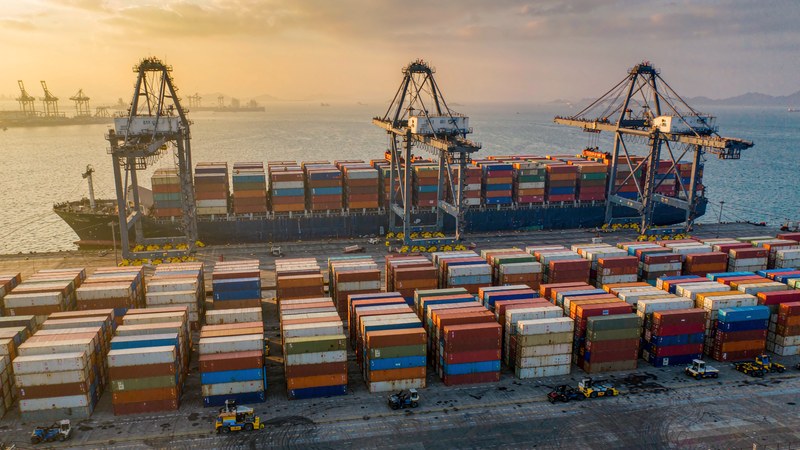
The Bureau of Customs has cleared 45 percent of the overstaying laden containers backing up Manila’s ports as of 9 November, part of an interagency push that has finalized a joint administrative order on port and container management ahead of the Christmas peak. For shippers serving Luzon, the cleanup math is finally moving in the right direction. For cargo bound for the Visayas and Mindanao, a second clock is still running: the domestic leg, where an inter-island vessel incident off Cebu in early November has added fresh uncertainty to feeder and transshipment schedules that were already the tightest link in the chain.
What the interagency order actually does
The joint administrative order, coordinated through a meeting led by the Department of Finance, sets a framework for port and container management, transparency in logistics charges, collection of lawful revenues, and controlled temporary admission of containers. Agencies also committed to expanding container-yard capacity through identified sites, with the Bureau of Customs exploring an additional location in nearby areas. Signatories span the departments of finance, trade and transportation as well as the Philippine Ports Authority, the Maritime Industry Authority, the Bureau of Internal Revenue and the Philippine Competition Commission – a list that matters because congestion rules now have multiple institutional owners instead of one port-level fix.
The immediate measures are as concrete as the paperwork. Customs has extended the schedule at designated examination areas in Manila and other congested ports from 8 a.m. to 5 p.m. to 8 a.m. to midnight, and the Bureau of Animal Industry ordered veterinary quarantine stations at the Manila International Container Port and the Port of Manila to operate around the clock. The customs bureau is looking at temporary yards, including a reported 100-hectare property in Bulacan and others in Cavite, to hold overstaying boxes. More frequent calls by sweeper vessels to evacuate empty containers clogging the yards are also on the list of medium-term measures.
The withdrawal ledger gives the cleanup its rhythm. Customs offices at the Port of Manila and the Manila International Container Port called on owners to pull 3,598 overstaying containers as of 26 October. By 4 November, 1,683 had been released, and importers had committed to clear the remaining 1,915 within weeks. The 45 percent figure reported as of 9 November matches that trajectory. Officials involved in the process have been candid that congestion is a complex problem the order alone will not fully resolve – a rare piece of straight talk that shippers should read as: the cleanup has a schedule, but the schedule is measured in months, not weeks.
What the congestion numbers still say
Independent operational data shows why the domestic leg deserves its own planning. Kuehne+Nagel’s weekly port operational update for the week of 4 to 10 November put Manila’s seven-day average vessel waiting time at around 2.31 days, with congestion remaining significant at both North and South Harbor terminals and yard utilisation at the Manila International Container Terminal holding at 80 to 85 percent – the same elevated band carriers have reported since October. Those figures describe the international gateway, not the islands.
A container that clears Manila is often only halfway through its journey. Cargoes bound for Cebu, Iloilo, Bacolod, Cagayan de Oro or Davao typically continue by feeder vessel, inter-island roll-on/roll-off service or domestic trucking, and each handoff adds days that do not appear in a berth-waiting statistic. Forwarder-published lane guides for the Philippines put the domestic add-on for sea freight at roughly five to ten days for Cebu destinations and seven to twelve days for Davao, with Palawan and General Santos trailing even further because inter-island sailing frequency, not distance, sets the pace.
The domestic leg has its own incident risk
That structure produced a live disruption in the first week of November. CMA CGM issued a customer advisory stating that an operational incident involving a domestic vessel occurred shortly after the M/V TB TAIYUAN’s departure from Cebu at 23:58 on 7 November 2026. The carrier said port, vessel and operational assessments were underway, that the vessel’s onward operation remained subject to clearances and coordination with the authorities, and that export shipments on the affected BMX service may experience delays in departure, transshipment connections and arrival at destination. The carrier’s own framing – “the overall impact on individual shipment schedules is still being assessed” – is the operative fact: a single incident on an inter-island loop propagates into connections across the Visayas and onward legs to Mindanao.
Inter-island shipping in the Philippines runs on a small number of operators and vessels, so disruption concentrates quickly. When an international service discharges at Manila and the onward feeder is late, the container misses the weekly or fortnightly inter-island sailing, and the next departure may be days away. When the international service discharges directly at Cebu or Davao, the same miss happens at the origin. Either way, the failure mode is the same: the international network recovers on container-ship schedules, and the domestic network recovers on a sailing calendar with far fewer departures to absorb the miss.
Two routings, priced honestly
For consignees in the central and southern Philippines, the choice this season is between two routings, each with a different risk profile. The first is the traditional Manila-first path: international discharge at Manila, customs clearance there, then a domestic transfer by feeder or RoRo. Its advantage is schedule breadth – more international services call at Manila than at any other Philippine port, so the international leg has redundancy. Its weakness is that every box takes the full domestic handoff, and during the cleanup period that handoff starts in the country’s most congested yards.
The second is direct discharge at a secondary gateway. Services that call at Cebu, Davao, Subic or Batangas skip the Manila yard entirely, and cargo oriented toward the Visayas or Mindanao moves to its final leg sooner. The trade-off is frequency and capacity: fewer sailings, fewer operators, and when an incident like the Cebu event of 7 November occurs, fewer alternatives nearby. Batangas, which has absorbed diverted traffic from Luzon, is the closest substitute for southern-Luzon and some Visayas flows; Subic serves northern and central Luzon better.
The pricing question shippers should ask forwarders is not which routing is cheaper per container, but which routing fails cheaper when it fails. A Manila-first box that misses an inter-island sailing accrues demurrage, detention and re-handling while it waits. A direct-discharge box that misses an onward leg may wait at a quieter yard with fewer sailings to catch. Both scenarios need the same protection: contractual free time matched to the domestic sailing interval, not to the international transit.
What to line up now
Three preparations cut the tail risk. First, confirm which of your lanes have direct international calls and which run Manila-plus-feeder, and put the sailing calendar – not the liner schedule – into the delivery promise. Second, for Manila-cleared cargo moving to the islands, align customs paperwork with the extended examination hours: the midnight cut-offs exist precisely so clearance does not push a container past its domestic sailing. Third, track the overstaying-container numbers monthly. The 3,598-to-1,683-to-45-percent sequence is the clearest public signal of whether the joint order is working, and the answer changes routing economics: every percentage point of yard relief shortens the queue ahead of a domestic handoff.
The constructive read of the season is that the international leg is now under institutional management with visible metrics, while the domestic leg rewards the shippers who plan around sailing frequency. Neither clock can be ignored, but only one of them is still unpredictable – and that is the one worth building buffer into.
Sources
- PortCalls Asia 🔗, “Port congestion: Gov’t finalizes JAO, adds quick fixes” (published 2026-11).
- Kuehne+Nagel 🔗, “Port operational updates from around the world (4 Nov – 10 Nov 2026)” (published 2026-11-10).
- CMA CGM 🔗, “Philippines: BMX Service – M/V TB TAIYUAN v. BMX0B0N89” (published 2026-11).
- AB Group Shipping 🔗, “Shipping Time to Philippines From USA: How Long?” (updated 2026-10).
This article was prepared by the expert team at Global Infinity Labs, drawing on insights and data provided through its MCP data services.
About Global Infinity Labs
Global Infinity Labs is an AI innovation company specializing in MCP data services.
Email: support@globalinfinitylabs.com
To share industry insights, report corrections, or submit story tips: editors@globalinfinitylabs.com or https://www.globalinfinitylabs.com/submit.