A report published on 9 November 2026 describes a shift in how foreign-owned company registrations are being reviewed: forms now probe the actual source of capital and the real decision-making structure, not just the shareholder list, and applications touching restricted sectors draw more clarification requests before approval. The mechanics behind that shift are not new rules but new verification weight on rules that already exist. Four instruments carry the load: the 13th Regular Foreign Investment Negative List, the amended Foreign Investments Act, the revised beneficial ownership disclosure rules, and the anti-dummy statute. Knowing which instrument answers which question is what separates a registration that clears in one pass from one that bounces between clarification rounds.
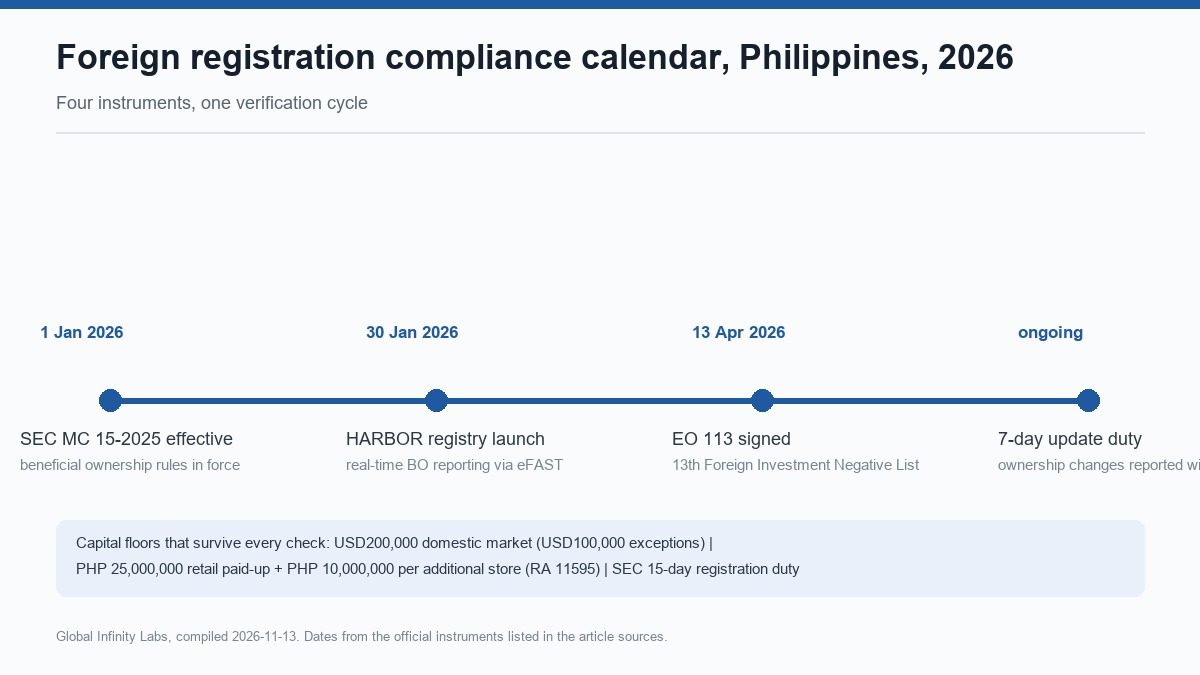
What the 13th negative list actually caps
The current Foreign Investment Negative List is the 13th regular edition, promulgated through Executive Order No. 113 and signed on 13 April 2026. It replaced the 12th list issued under Executive Order No. 175 of 2022, which means any checklist still quoting EO 175 as the operative list is out of date. The document has two parts. List A holds restrictions that come from the Constitution and specific statutes, so it moves whenever those laws move. List B holds restrictions justified by security, defence, health and the protection of small and medium enterprises, and may be amended at most once every two years.
List A carries the headline ceilings. Mass media must be wholly owned and managed by citizens. Corporations holding private land need at least 60 percent Filipino ownership, though a foreign-owned company can lease instead. Exploration and development of natural resources is open only to corporations at least 60 percent nationally owned, apart from agreements the Constitution itself authorizes. Practiced professions sit under their own licensing laws rather than the corporate code, and a professional corporation cannot practice a profession unless a special law allows it.
Retail trade runs on a separate statute. Under Republic Act No. 11595, a foreign retailer needs minimum paid-up capital of PHP 25,000,000, plus PHP 10,000,000 per physical store once it operates more than one store. The law also requires reciprocity: the foreign retailer’s home country must not bar Filipino retailers from operating there. These figures are statutory floors, not administrative guidance, so no filing step can waive them.
The capital floors and where they drop to USD100,000
For everything outside retail and the negative list, the general rule reads the other way. The Foreign Investments Act, as amended by Republic Act No. 11647 in 2022, allows a non-Philippine national to invest up to 100 percent of a domestic enterprise’s capital without prior approval, unless a law or the negative list caps the share. The same amendment instructs the corporate regulator not to add ownership limits of its own and to register a complete application within fifteen days. The constraint that trips most filings is a different clause: every micro and small domestic market enterprise with paid-in equity below USD200,000 is reserved to nationals.
The USD200,000 floor carries three statutory exceptions that drop it to USD100,000. The first applies where the business involves advanced technology as determined by the science and technology department. The second covers qualifying startup status. The third applies where the enterprise directly employs at least 15 Filipino workers. Each exception is conditional and evidence-based; the payroll route, for instance, needs a Filipino-majority direct workforce documented in the file. An export enterprise sits outside the domestic-market test entirely, which is why the classification of the company’s customer base matters before the capital figure is chosen.
The USD figure is a paid-in equity test, not a filing fee and not a substitute for a peso conversion. Converting the statutory dollar reference into a fixed peso budget requires a dated exchange rate and the specific legal test at filing time. Teams that treat the USD200,000 as a one-line cost item tend to discover at the bank stage that the certificate of inward remittance, which evidences that the capital actually entered the country, is itself now subject to fuller know-your-customer checks before the bank issues it.
Beneficial ownership reporting moved out of the annual form
A second verification layer sits outside registration altogether. SEC Memorandum Circular No. 15, Series of 2025, the revised beneficial ownership disclosure rules, took effect on 1 January 2026. Under the new regime, the annual general information sheet no longer carries a beneficial ownership section; that information lives in the HARBOR registry, a web platform launched on 30 January 2026 and integrated with the regulator’s eFAST filing portal. Because the platform feeds regulators in real time, disclosure is now an ongoing obligation with its own timeline rather than an annual checkbox.
The reporting trigger is any natural person who ultimately owns, controls or benefits from the corporation, traced through every layer of the structure. Category A alone captures anyone holding at least 20 percent of voting shares, and further categories reach control exercised through contractual arrangements, proxy voting or director-appointment rights. Each reported individual requires name, residential address, date of birth, nationality, contact details, tax or passport identification, civil status and politically-exposed-person status. Ownership changes must be reported within seven calendar days of occurrence, and the penalty regime for persistent non-compliance reaches fines of up to PHP 2,000,000 and, in the worst cases, dissolution proceedings.
For a foreign shareholder, the practical consequence is that the cap table filed at registration and the beneficial ownership record in HARBOR must describe the same reality at all times. A share transfer executed offshore on a Monday is reportable within the week, even when nothing else about the local company changed.
The nominee problem and the penalties behind it
The reason regulators lean harder on verification is the pattern the anti-dummy statute exists to punish. Commonwealth Act No. 108, as amended, criminalizes arrangements where citizens lend their names to let foreign parties evade nationality requirements. Penalties run from five to fifteen years of imprisonment, fines of no less than the value of the right or privilege illegally enjoyed, deportation for the foreign principal involved, and cancellation of registrations and licenses. The statute also reaches control, not just title: directing a restricted enterprise through board votes, signing authority or contractual vetoes beyond the permitted equity counts as intervention, even when the share register looks clean.
Enforcement coordination among the corporate regulator, the justice department and the immigration bureau has intensified through 2026, and the registry’s real-time beneficial ownership data is precisely what makes the classic mismatch visible: filings showing one ownership split, tax returns and board minutes showing another. The recurring tells are informal side contracts giving a foreign party control beyond its equity cap, a foreign signatory exercising authority the equity does not permit, and proxy arrangements that push voting power past the legal ceiling.
Where the grey areas sit
Two structures generate most of the avoidable friction. The first is the mixed-purpose company that bundles a restricted activity with an unrestricted one and averages the ownership across both. The rule is per-activity: each line item is tested against the negative list on its own terms, and a general trading label can conceal retail, import or regulated work that carries a different ceiling. The second is the nominee arrangement, where the local shareholder holds shares on paper with no real stake. Beyond being criminal exposure for both sides, it provides no fallback when the registration file is cross-checked against operating reality, because the mismatch is exactly what the current verification cycle is built to surface.
None of this amounts to a closing door. Outside the negative list, full foreign ownership remains available, the fifteen-day statutory registration clock still runs on complete applications, and the 2026 instruments opened more activities than they closed. The verification push changes the evidence standard, not the permission standard: registrations now need a documented money trail, an ownership record that updates within seven days of any change, and a structure whose control matches its cap table. Files that arrive with those three elements complete move faster than they did before; files that rely on templates do not.
Sources
Sources:
- ACFTL, “Philippines Tightens Rules on Foreign Business Registration,” 2026-11-09. https://acftl.org/philippines-tightens-rules-on-foreign-business-registration-2/
- Executive Order No. 113 (13th Regular Foreign Investment Negative List), signed 2026-04-13, via Official Gazette / Supreme Court E-Library.
- Republic Act No. 11595 (Retail Trade Liberalization Act amendments), 2021-12-10, Supreme Court E-Library.
- Republic Act No. 11647 (Foreign Investments Act amendments), 2022, Supreme Court E-Library.
- SEC Memorandum Circular No. 15, Series of 2025 (Revised Beneficial Ownership Disclosure Rules), effective 2026-01-01; HARBOR registry launched 2026-01-30.
- Korp.ph, “What Is the SEC HARBOR Registry?” and “Anti-Dummy Law guide for Philippine startups,” reviewed 2026-11-13. https://www.korp.ph/blog/what-is-the-sec-harbor-registry-a-simple-guide-for-philippine-business-owners
- Global Law Experts, “Using a Foreign Holding Company to Invest in the Philippines (2026),” reviewed 2026-11-13. https://globallawexperts.com/news/foreign-holding-company-philippines
- MyDavaoBase, “Registering a Company in the Philippines as a Foreigner,” reviewed 2026-11-13. https://mydavaobase.com/the-feed/register-company-philippines-foreigner
This article was prepared by the expert team at Global Infinity Labs, drawing on insights and data provided through its MCP data services.
About Global Infinity Labs
Global Infinity Labs is an AI innovation company specializing in MCP data services.
Email: support@globalinfinitylabs.com
To share industry insights, report corrections, or submit story tips: editors@globalinfinitylabs.com or https://www.globalinfinitylabs.com/submit.