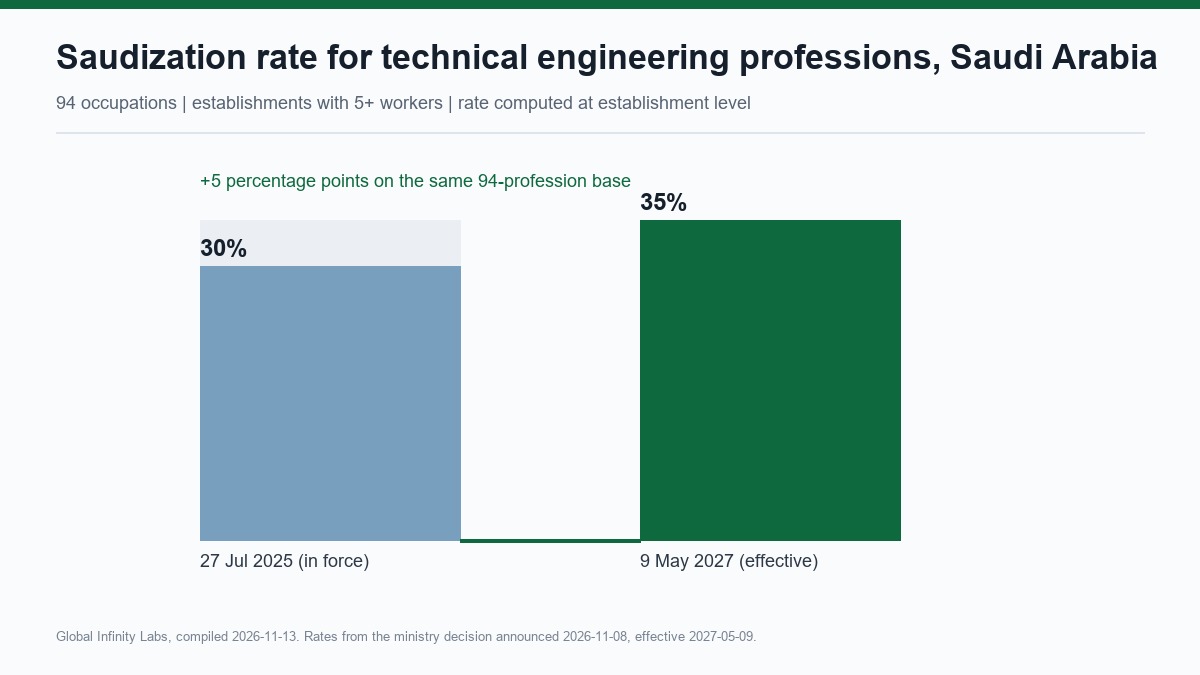
On 8 November 2026, the Ministry of Human Resources and Social Development, working with the Ministry of Municipalities and Housing, announced that the Saudization rate for 94 technical engineering professions in private sector establishments will rise from 30 percent to 35 percent, effective 9 May 2027. The six-month runway is deliberate: establishments in scope have until May to adjust headcount before the higher floor binds, and the calculation method is fixed in advance rather than left to field interpretation. For engineering-heavy contractors, consultancies and industrial operators, the decision changes the compliance arithmetic on every project staffing plan that runs past the second quarter of 2027.
What the decision covers
The 94 professions are technical engineering occupations classified under the Saudi Standard Classification of Occupations. Published lists name civil engineering technicians, electrical engineering technicians, mechanical engineering technicians, electronic engineering technicians, surveying technicians, mechanical maintenance technicians and architectural draftsmen, among others in the same occupational family. The common thread is technician-grade technical work: roles that support licensed engineers rather than duplicate them, which is where past localization rounds found the largest substitutable expatriate headcount.
Two scope rules determine who counts. The first is a size gate: the requirement applies to private sector establishments employing five or more workers in the targeted professions. Establishments below that threshold in these occupations stay outside the mandate. The second is the counting unit: the rate is calculated at the establishment level, in accordance with the ministry’s procedural guide, not at the company or group level. A parent company cannot average a compliant site against a non-compliant one; each registered establishment carries its own ratio, computed from the occupations its workers hold under the standard classification.
The procedural guide has been published on the ministry’s website and does the definitional work that determines compliance: which professions are covered, how the Saudization rate is calculated, the implementation mechanisms and the compliance requirements. Since the rate turns on occupation classification, an establishment whose job titles do not match its workers’ actual classification codes will compute a different ratio than the ministry does. Reconciling internal job architecture against the standard classification is therefore the first work item, before any hiring or redeployment decision.
The baseline it builds on
The new floor is a five-point step, not a new regime. The ministry had already enforced a 30 percent Saudization requirement for technical engineering professions in establishments with five or more workers, effective from 27 July 2025. The 2027 decision raises that existing requirement by five percentage points on the same occupational base and the same counting unit, which makes the change easier to cost: establishments that met the 2025 requirement know their denominator, and the adjustment is incremental headcount in the covered occupations rather than a rebuild of the compliance framework.
The sequencing also signals method. Specialized professions are being localized in staged rounds, each announced with a defined effective date months ahead, a published procedural guide and a support package running alongside. For workforce planners, the pattern matters as much as the current number: occupation families that have already seen one staged increase are the natural candidates for the next one, and the interval between announcement and enforcement has been long enough to plan against.
What employers must do before 9 May 2027
The compliance sequence for the next six months runs through four steps. First, map the establishment’s headcount against the 94 covered occupations using the standard classification codes, and compute the current establishment-level rate from the guide’s method. Second, quantify the gap between that figure and 35 percent, expressed in the covered occupations specifically; hiring outside the covered list does not move the ratio. Third, close the gap through the ministry’s support channels, which the announcement describes as a comprehensive package covering assistance with recruitment, training, qualification, employment and job stability, plus priority access to Saudization support programs. Fourth, verify the resulting ratio against the guide’s calculation rules before the effective date, since the enforcement check will recompute from the same definitions rather than from internal HR categories.
The support package matters for feasibility. Saudization targets in technical occupations are constrained by the supply of qualified nationals, which is why the ministry pairs each mandate with training and qualification programs rather than leaving establishments to bid against each other for an unchanged talent pool. Establishments that engage the qualification channels early hold a timing advantage over those that wait for the effective date and then compete for already-certified candidates.
Why engineering, and what the skills data says
The choice of occupation family is grounded in the ministry’s own commissioned research. A World Bank study, “Upskilling: Required Skills and Workforce Development in Saudi Arabia,” prepared at the ministry’s request, surveyed 3,016 private sector establishments across the kingdom’s 13 regions between May and October 2024. Its findings describe the constraint the decision addresses: 61 percent of businesses said gaps in employee capabilities had cost them potential profits, 55 percent reported lost business opportunities, and 48.5 percent said capability gaps had affected the quality of their products and services.
The same study maps where the workforce actually sits: retail, hospitality and food services account for 43 percent of the surveyed workforce and construction another 19.7 percent. That composition helps explain why the localization program keeps moving into technical and engineering occupations rather than stopping at retail categories; sectors that rely less heavily on advanced capabilities absorb most existing national employment, while the specialized professions remain expatriate-heavy. The study’s recommendation runs in the same direction as the quota increase: move employment toward higher-productivity activities that use advanced skills, rather than protecting low-skill headcount.
The wider enforcement backdrop and the grey areas
The quota increase lands in an already tightening enforcement environment. On 4 November 2026 the ministry announced enforcement action against recruitment offices, suspending 66 agencies and revoking one license for violations in the recruitment chain, according to the ministry’s own announcement as reported internationally. Read together with the staged quotas, the signal is that compliance is being checked on both sides of the labor market: the demand side through establishment-level ratios and the supply side through the offices that move workers into the kingdom.
A worked example shows how the arithmetic lands. An establishment holding 20 workers across the covered occupations needs 7 of them to be Saudi nationals at 35 percent, against 6 at the current 30 percent; the guide’s calculation method governs how fractional results are treated, so the first step is still reading the method rather than assuming standard rounding. The same establishment with 12 covered workers needs 5 at the higher floor against 4 at the lower one, a full additional headcount. Establishments running multiple sites each run this calculation separately, and a group with ten establishments may carry ten distinct gaps even when the group total looks comfortable on a spreadsheet.
Two grey areas deserve explicit treatment in staffing plans. The first is the establishment-versus-company distinction, which penalizes internal reallocation strategies: moving a covered technician from a compliant site to a non-compliant one fixes neither ratio and can break both. The second is the classification question, since technician roles defined by function rather than by job title can fall inside or outside the 94 depending on how the establishment’s records map to the standard classification. Establishments expecting to sit near the boundary should document their mapping before the effective date rather than after the first inspection finds a discrepancy. The ministry’s procedural guide is the operative text for both questions, and it is already published, which leaves six months to reconcile against it rather than to guess at it.
Sources
Sources:
- Saudi Gazette, “Saudization rate raises to 35% for 94 technical engineering professions, effective May 9, 2027,” November 2026. https://saudigazette.com.sa/article/611717/SAUDI-ARABIA/Al-Rajhi-signs-pacts-with-Burundi-minister-to-recruit-domestic-help?format=simple
- Ministry of Human Resources and Social Development decision and procedural guide (with the Ministry of Municipalities and Housing), announced 2026-11-08, guide published on hrsd.gov.sa.
- People Matters Middle East, “Saudi Arabia to raise Saudisation rate to 35% across 94 engineering technical occupations from May 2027,” 2026-11-08. https://me.peoplemattersglobal.com/news/economy-policy/saudi-arabia-to-raise-saudisation-rate-to-35percent-across-94-engineering-technical-occupations-from-may-2027-53271
- ETHRWorld EMEA, “Saudi Arabia lifts saudisation rate to 35% for 94 engineering roles,” 2026-11-10. https://hrme.economictimes.indiatimes.com/news/industry/saudi-arabia-lifts-saudisation-rate-to-35-for-94-engineering-roles/135697018
- World Bank, “Upskilling: Required Skills and Workforce Development in Saudi Arabia,” prepared at the request of the Ministry of Human Resources and Social Development; survey of 3,016 establishments, May-October 2024.
- Zawya / SyndiGate, “Saudization rate raises to 35% for 94 technical engineering professions,” November 2026. https://www.zawya.com/en/economy/saudization-rate-raises-to-35-for-94-technical-engineering-professions-effective-may-9-2027-2126599
- Legit.ng, “Saudi Arabia Changes Employment Rules for Foreigners in 94 Occupations,” 2026-11-08; enforcement action against recruitment offices reported 2026-11-04.
This article was prepared by the expert team at Global Infinity Labs, drawing on insights and data provided through its MCP data services.
About Global Infinity Labs
Global Infinity Labs is an AI innovation company specializing in MCP data services.
Email: support@globalinfinitylabs.com
To share industry insights, report corrections, or submit story tips: editors@globalinfinitylabs.com or https://www.globalinfinitylabs.com/submit.