By: Alex Mercer – SeaPRwire – A closed-loop RFID system for hospital workwear and linen just claimed 97 percent traceability. One delivery worker now covers morning restock and afternoon collection at a 3000-staff site. Staffing for that task dropped 80 percent. That is the number that matters. Manual counts and single-barcode scans cannot match it.
Official release facts list the full stack. ZHILAI MED announced an RFID-powered smart textile management solution on 10 October 2026 from Shenzhen. It targets healthcare facilities and industrial laundries. The goal is better traceability, efficiency and digital control of workwear, uniforms, linens and other reusable textiles. The system combines RFID identification, automated workwear dispensers, return units, laundry inventory tools and cloud software. Together they form a closed loop. Every textile item receives a unique RFID identity. It is tracked from registration through distribution, use, return, washing, inventory and reissue. RFID reads multiple items at once. Manual records or barcodes require one-by-one scanning. The difference gives clearer visibility into circulation and stock levels. The Automatic Workwear Dispenser holds up to 500 uniforms. Authorized staff get 24-hour self-service access. Authentication works by facial recognition, staff cards, QR codes or passwords. Low-inventory alerts flag when stock runs short. The Return Unit pairs RFID with infrared detection. It identifies returned garments in under three seconds. The unit occupies roughly 0.6 square meters. Compact size suits tight healthcare spaces. It also detects metal objects inside returned workwear. If metal is present the compartment stays locked. That step cuts hospital asset loss and shields laundry staff from hazardous items. The cloud platform shows real-time inventory and movement data. It links to existing hospital staff-card or HR systems. It logs status and history for each textile piece. It produces department-level washing and cost reports. In project deployments the solution reached a 97 percent textile traceability rate. One hospital with about 3000 staff needed only a single delivery employee for morning restocking and afternoon collection. Related staffing requirements fell by 80 percent. The system is already live in more than 200 healthcare institutions. Hong Kong sites include Queen Mary Hospital, Pamela Youde Nethersole Eastern Hospital and Kowloon Hospital.
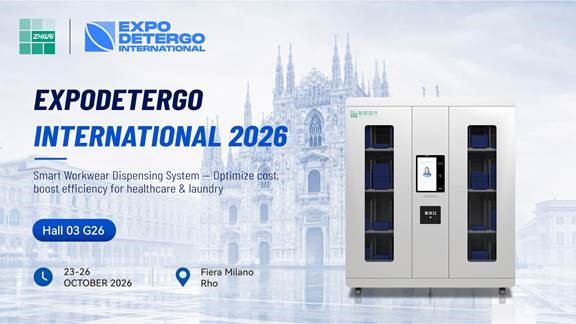
Industry subtext sits next to those figures. Laundry and workwear still run on paper lists or slow barcode lines in many hospitals. RFID bulk reads and automated dispensers remove that friction. The metal-detection lock on the return unit addresses a concrete hospital risk. Asset loss and needle-stick hazards for laundry crews are real costs. The cloud layer turns every wash cycle into department cost data. That report is what finance teams actually use. ZHILAI MED is a subsidiary of ZHILAI Technology. Manufacturing sits in two bases, one in Xianning, China, and one in Binh Duong, Vietnam. Annual capacity exceeds 200,000 units. Production is fully automated and lean. The parent offers OEM and ODM services worldwide. The company will show the dispenser, return unit and full management suite at EXPOdetergo International 2026 in Milan. Dates are 23 to 26 October. Location is Hall 03, Booth G26.
Supply-chain reality for this class of hardware is straightforward. High unit volume and dual-country production keep the cost base low enough for hospital budgets. Deployments already past 200 sites prove the loop works outside the pilot stage. Hospitals that still count textiles by hand can start with the same dispenser-plus-return pair that cut staffing 80 percent at the 3000-staff site. That is the practical next step.
Author bio: Alex Mercer, a Silicon Valley tech director and systems analyst who has spent years inside RFID deployments, automated logistics hardware and hospital operational tech.