By: Alistair Kroon – SeaPRwire – Fifteen years of silence ended with a notepad. On August 3 Japan’s Finance Minister Katayama Satsuki confirmed what markets had already priced in days earlier. The United States and Japan had jointly intervened in the yen. The last time the two governments moved together was 2011. This time the trigger was not a natural disaster. It was a currency sliding toward 164 against the dollar and the quiet fear that Tokyo might start dumping its vast holdings of American debt to defend the yen alone.
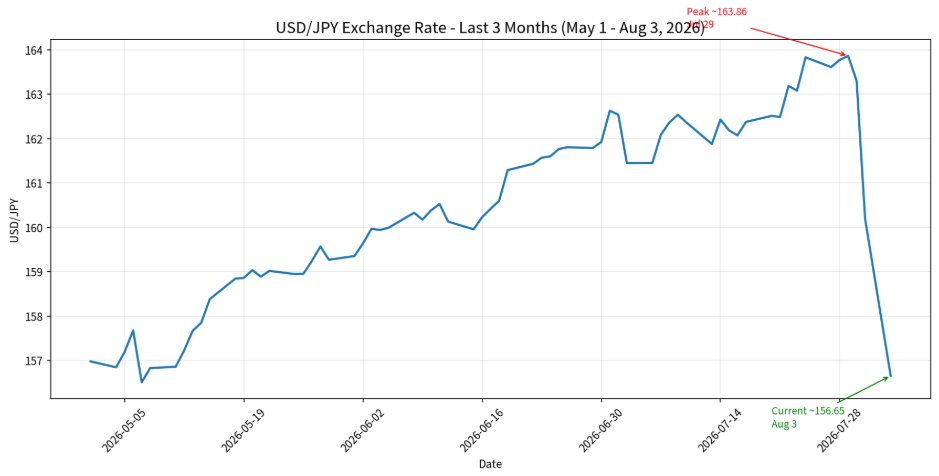
Official language stays carefully measured. Katayama said the two countries would not hesitate to act again. Treasury Secretary Bessent posted that the coordinated action had checked disorderly moves in the yen. He added that the Trump administration strongly supports Japan’s steps to correct a sharply undervalued currency. President Trump himself told reporters the United States was simply helping Japan strengthen the yen because it had been getting softer and Tokyo wanted a bit of assistance. The operational detail is more revealing. The intervention used the Fed’s FIMA repo facility. Japan pledged Treasuries for short-term dollars instead of selling them into the open market. As of the end of May Japan still held 1.14 trillion dollars in U.S. government paper, the largest foreign stockpile. Earlier this year Tokyo had already spent nearly 12 trillion yen in April and May. Those buys produced only temporary relief. By late July the yen was again testing 40-year lows near 164.
The real calculation sits behind the public statements. Market participants and analysts quoted across the reports see the American participation as defensive. Oxford Economics’ Louise Loo noted that Washington’s core worry was the risk of large-scale Japanese Treasury sales if Tokyo intervened alone. Such sales would push U.S. yields higher at a moment when they were already rising after the Fed held rates steady. State Street’s Masahiko Loo called the FIMA signal more important than the intervention size itself. It told the market that Japan would not be forced to liquidate short-term Treasuries and disrupt American funding markets. Estimates of the latest operation range from 5 to 10 trillion yen, timed for the New York session when liquidity is deepest. The yen snapped back from near 164 to the mid-156 area within days. Importers in Japan are already placing dollar-buy orders clustered between 157 and 159. Bank strategists at Sumitomo Mitsui and Resona expect the rate to settle back toward 160 once the immediate shock fades.
Intervention buys calendar time. It does not rewrite the underlying arithmetic. Japan’s bond market remains repressed by continued large-scale purchases even after the formal end of yield-curve control. Fiscal concerns around the current government add another layer of pressure. As long as Japanese yields stay artificially low relative to free-market levels, the yen carries a structural depreciation bias. Brooks at Brookings put it bluntly: intervention cannot reverse a trend driven by the domestic bond market. The practical takeaway for anyone holding yen exposure or watching Treasury yields is straightforward. Treat every coordinated statement as a temporary ceiling, not a floor. Position for the next leg lower once the political cover thins. Author bio: Alistair Kroon, a veteran geopolitical commentator whose columns appear regularly in major international newspapers and focus on great-power financial statecraft.