By: Marcus Sterling – SeaPRwire – Ursula von der Leyen put the offer on the table. On 16 September she told the European Parliament she wants Canada as the European Union’s first joint member. Mark Carney answered the next day in Strasbourg. He said Canada and the EU stand together in hard times as well as good ones. Washington’s reaction landed the same day. Donald Trump signed a memo that cuts Canadian products out of U.S. federal civilian procurement. He warned the move could count as a hostile act and threatened heavy tariffs if Europe acted with malice. The sequence is public. The pressure is real.
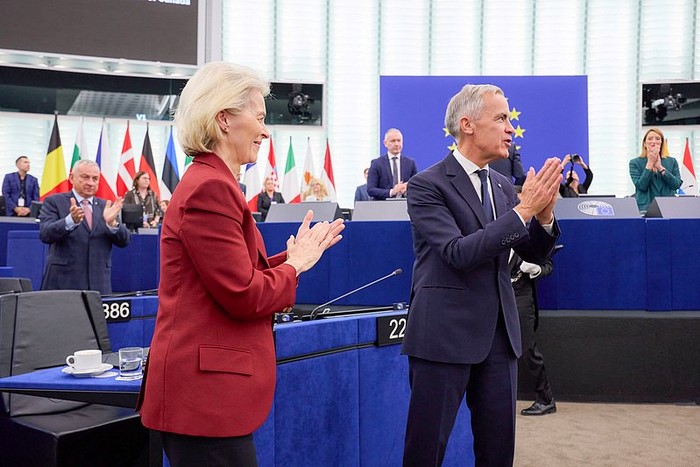
Official words from both sides now sit next to the practical signal they send. Von der Leyen said the EU and Canada would move from the existing Comprehensive Economic and Trade Agreement toward a common space of prosperity and economic security. She stressed the relationship is not aimed at any third party and that the Union wants the highest possible level of ties. Carney’s office welcomed the idea as a unique and positive step built on shared strengths. The same statement listed talks on critical minerals, energy, defence, advanced technology, strategic autonomy and sovereignty. These are the statements as given. The subtext is clearer. Both partners face high U.S. tariffs and shifts in American alliance policy. Forming a tighter horizontal link is a way to share the load. The existing trade deal supplies a ready base. The new language of joint membership raises the political temperature without requiring full EU accession.
The same week the American response locked in the stakes. Trump’s memo removed Canadian goods from federal civilian buying lists. He called Canada a terrible trading partner. He said heavy tariffs or a halt to certain trade flows would follow if he judged the European step hostile. Analysts noted in the same reporting that both Ottawa and Brussels already depend heavily on U.S. trade and investment. Any deeper Canada-EU fusion still leaves them exposed in key security domains. Yet the political signal travels farther than the economic numbers. Traditional transatlantic relations rested on a hierarchy that kept Washington at the center. Closer Canada-EU coordination begins to loosen that hierarchy. It does not break the alliance. It does change the internal balance of who talks to whom first.
The pendulum has moved. Canada and the European Union are testing a tighter circle while the United States tests how far it will push back. The joint-member proposal and the procurement ban are already on the record. The next test is whether the talk of critical minerals, defence and strategic autonomy produces concrete contracts or stays at the level of speeches. Until those contracts appear, the only firm fact is the open friction.
Author bio: Marcus Sterling, a veteran geopolitical commentator whose columns appear regularly in major international newspapers and who specializes in transatlantic alliance shifts and great-power economic pressure.