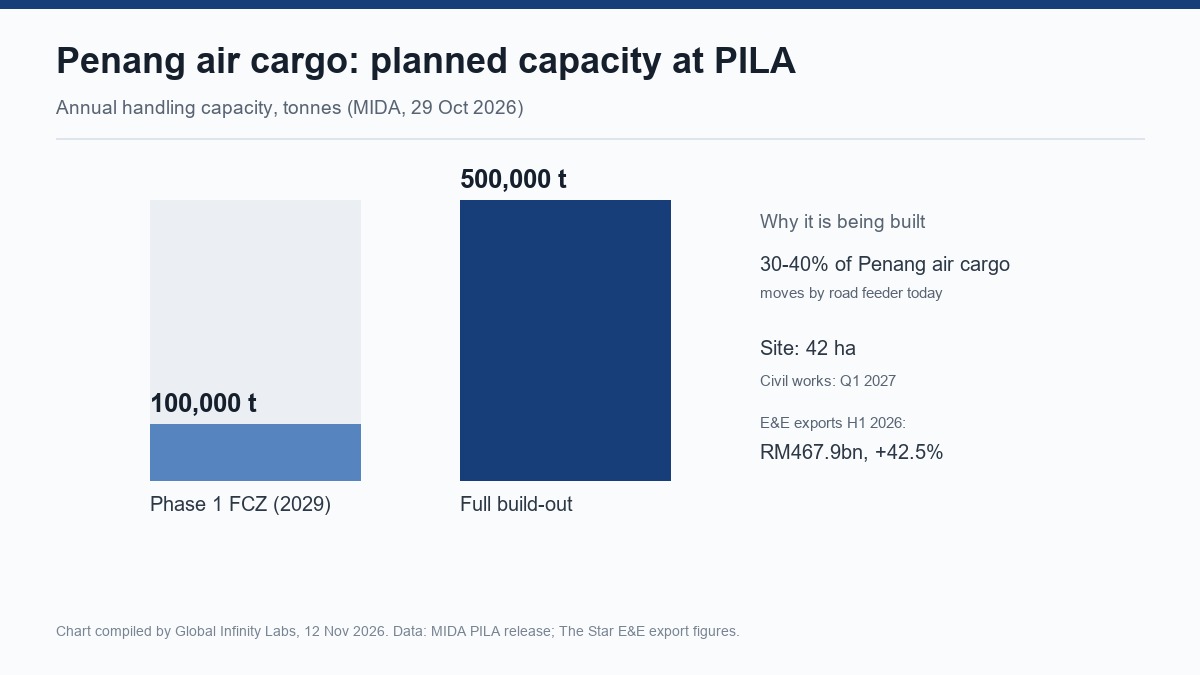
Penang’s new air cargo park is built on a 42-hectare site, with main construction scheduled for the first quarter of 2027 and a Free Commercial Zone warehouse targeted for 2029. The Malaysian Investment Development Authority published those dates on 29 October 2026 in its description of the Penang International Logistics Aeropark (PILA). The project is an institutional response inside the malaysia e&e supply chain: a cargo facility, a digital single window and a dedicated heavy-vehicle lane, all designed around high-value, time-sensitive electronics.
Dates here matter more than adjectives.
Ground works are under way. The master plan approval is already in hand.
The 42-hectare node and its dates
PILA was formally established through a joint venture agreement signed on 13 April 2026 between Penang Development Corporation and Malaysia Airports Holdings Berhad, with the first phase executed by Penang International Logistics Aeropark Sdn. Bhd. The published scope gives a first-phase air cargo warehouse inside a Free Commercial Zone, adding 100,000 tonnes of annual handling capacity on completion in 2029. Full build-out is described as more than 2 million square feet of warehouse space with total handling capacity up to 500,000 tonnes per year. Those are engineering figures from an agency page, and they belong in a site file as dated milestones.
The supporting systems are as specific. A single-window digital logistics platform is listed for paperless processing. A 24-hour express lane is reserved for strategic cargo tied to new product introduction. A dedicated heavy-vehicle lane is included to cut road vibration that can damage shock-sensitive electronic components. MIDA also lists two incentive instruments in the same description, the Smart Logistics Complex incentive and International Integrated Logistics Services status. Together they tell a freight forwarder what the malaysia e&e supply chain is trying to shorten: transfer time, damage exposure and cost risk on high-value shipments.
None of these items requires a company name.
Why 30 to 40 per cent of air cargo still moves by road
The agency page states that 30 to 40 per cent of air cargo generated in Penang currently moves by road feeder to external hubs before onward flight, because long-haul freighter services to North America and Western Europe are limited. That is a routing fact. It explains why a local cargo park has a business case without requiring any judgement about another market’s policy or efficiency. For the malaysia e&e supply chain, the extra road leg is a cost line before it is anything else. For a logistics planner the number is a baseline: roughly a third of volume carries an extra handover and an extra dwell window.
Each handover adds a handling event. Shock-sensitive semiconductor and assembly output is the cargo type the project is designed around, which is why the heavy-vehicle lane and vibration control appear next to the warehouse capacity in the same source. A 24-hour express lane for new product introduction sits on the same logic: a sample or a first batch loses value when it waits for a consolidated flight. The published description frames the project’s objective as shorter transfer time, lower damage exposure and lower freight cost risk.
The 2027 Q1 main construction date and the 2029 warehouse target are therefore planning inputs, not available capacity. A team quoting malaysia e&e supply chain capacity from the 500,000 tonnes figure is reading a full-build-out design number as a current operating number. The first-phase commitment is 100,000 tonnes at 2029 completion.
What the malaysia e&e supply chain already holds
A capability list is more honest than a migration story. The Star’s 31 October 2026 industry account, using official statistics, describes the sector moving from assembly, test and packaging into advanced packaging, equipment, materials, automation, research and IC design. JTM Asia’s 2026-2027 manufacturing overview adds a local automation and inspection equipment cluster around Penang, and records approved investment in machinery and equipment of RM11 billion in 2025 and RM7.5 billion in the first half of 2026. MIDA figures cited there put electrical and electronics, machinery, chemicals, transport equipment and food at 76.9 per cent of approved manufacturing investment in the first half of 2026.
On the ground, the segments that can be named from these sources are assembly, test and packaging, printed circuit board and electronics assembly, automation and inspection equipment, precision parts, and warehousing with third-party logistics. Two 2026 facility openings appear in the same overview, one advanced packaging plant commissioned in February at about RM800 million and one wafer-equipment supercentre first phase opened in June with a planned investment above RM400 million. Neither company is named in the summary used here, and no endorsement is implied by listing the amounts.
These are capability statements, not company claims.
The New Incentive Framework took effect on 1 March 2026, with incentives tied to technology development, skilled employment, local supply chain participation and sustainability metrics, according to the same manufacturing overview. For a supplier deciding whether to qualify locally, that effective date is the line between an older incentive conversation and the current one. It is also the kind of dated rule that belongs beside the engineering milestones in a file on the malaysia e&e supply chain.
Where the chain is not local
The question behind this topic asked which supporting segments remain local and which have left. The published material contains no direct statistic on facilities relocating out of the country, and no such claim is made here. What the sources do support is a list of chain stages that are not localised, which is where the malaysia e&e supply chain still stops short of a complete stage set: front-end advanced-node wafer fabrication, long-haul intercontinental freighter routes, and a skilled-worker gap. The National Semiconductor Strategy figures in The Star’s account put trained high-skilled workers at more than 18,000 with a target of 60,000, and approved investment at over RM91 billion as of the first quarter of 2026.
The 30 to 40 per cent road-feeder figure is the logistics form of the same gap. A cargo park and an FCZ warehouse address handling and customs geography. They do not create a long-haul freighter schedule. A site-selection file that treats the 2029 capacity number as a substitute for route availability has confused a facility with a network.
A capability gap is not a departure.
Three readings of the export share
Electrical and electronics exports rose 42.5 per cent year on year to a record RM467.9 billion in the first half of 2026, close to half of national exports, according to official figures quoted on 31 October 2026. Two other numbers circulate for September 2026. A second-hand account of a monthly external trade release dated 19 October 2026 puts that month’s E&E exports at RM110.23 billion, up 69.2 per cent and equal to 51.2 per cent of total exports. The Ledger Asia’s 30 October 2026 report gives September domestic exports up 54.7 per cent, with E&E products near 46 per cent and up 72.5 per cent.
These are three different measurements. The first is a half-year cumulative figure. The second is a single month on a total-export basis. The third is a single month on a domestic-export basis. Publishing bodies and release dates differ as well. Keeping them in separate rows is the minimum standard for anyone quoting malaysia e&e supply chain concentration in a client memo, and the second-hand monthly figure should not carry weight as a load-bearing fact.
Read as structure, the numbers still say something useful. When one product category accounts for roughly half of an export base, a change in that category’s order book moves the aggregate without any other sector moving. That is a concentration mechanism, not a forecast. The same 31 October 2026 account records RM6 billion of approved E&E investment in the first quarter of 2026, the highest among manufacturing subsectors, and RM319 billion cumulatively from 2021 to 2025. Both are period-labelled approval figures.
What a site-selection file should carry
Put the dated items first. The 13 April 2026 joint venture agreement, the master plan approval, the 2027 Q1 main construction slot, the 2029 FCZ warehouse target, the 100,000 tonnes first-phase capacity and the 500,000 tonnes full-build-out design number each need their own row. The 1 March 2026 incentive framework effective date goes in the same table. A file organised this way survives a schedule slip without a rewrite.
Then keep the capability list and the gap list separate. Local assembly, test and packaging, board assembly, automation equipment, precision parts and third-party logistics sit on one side. Front-end wafer fabrication, intercontinental freighter routes and the 18,000 to 60,000 skilled-worker gap sit on the other. Neither list is a claim that firms have moved. That is what the malaysia e&e supply chain looks like when the published sources are read as an inventory of stages.
Finally, attach the export-share rows with their periods and definitions, and mark the September monthly figures derived from a second-hand account as such. A planner who can point to which half-year or single-month series a percentage came from will not be caught mixing a cumulative rate with a monthly share. For freight forwarders, industrial park teams and equipment suppliers, that discipline is the practical output of this malaysia e&e supply chain review.
Sources
- Malaysian Investment Development Authority (MIDA), “Penang International Logistics Aeropark (PILA)” (29 October 2026). https://www.mida.gov.my/penang-international-logistics-aeropark-pila-powering-the-make-in-penang-fly-from-penang-revolution-in-global-ee-and-semiconductor-logistics
- The Star, “Advancing Silicon Malaysia” (31 October 2026). https://www.thestar.com.my/starpicks/2026/10/31/advancing-silicon-malaysia
- JTM Asia, “Malaysia Manufacturing Landscape 2026-2027: Major Industries, Developments & Outlook”. http://jtmasia.com/en/news/malaysia-manufacturing-landscape.html
- The Ledger Asia, “Malaysia Semiconductor Upcycle Lifts Export and Growth Outlook” (30 October 2026). https://theledger.asia/?p=43493
This article was prepared by the expert team at Global Infinity Labs, drawing on insights and data provided through its MCP data services.
About Global Infinity Labs
Global Infinity Labs is an AI innovation company specializing in MCP data services.
Email: support@globalinfinitylabs.com
To share industry insights, report corrections, or submit story tips: editors@globalinfinitylabs.com or https://www.globalinfinitylabs.com/submit.