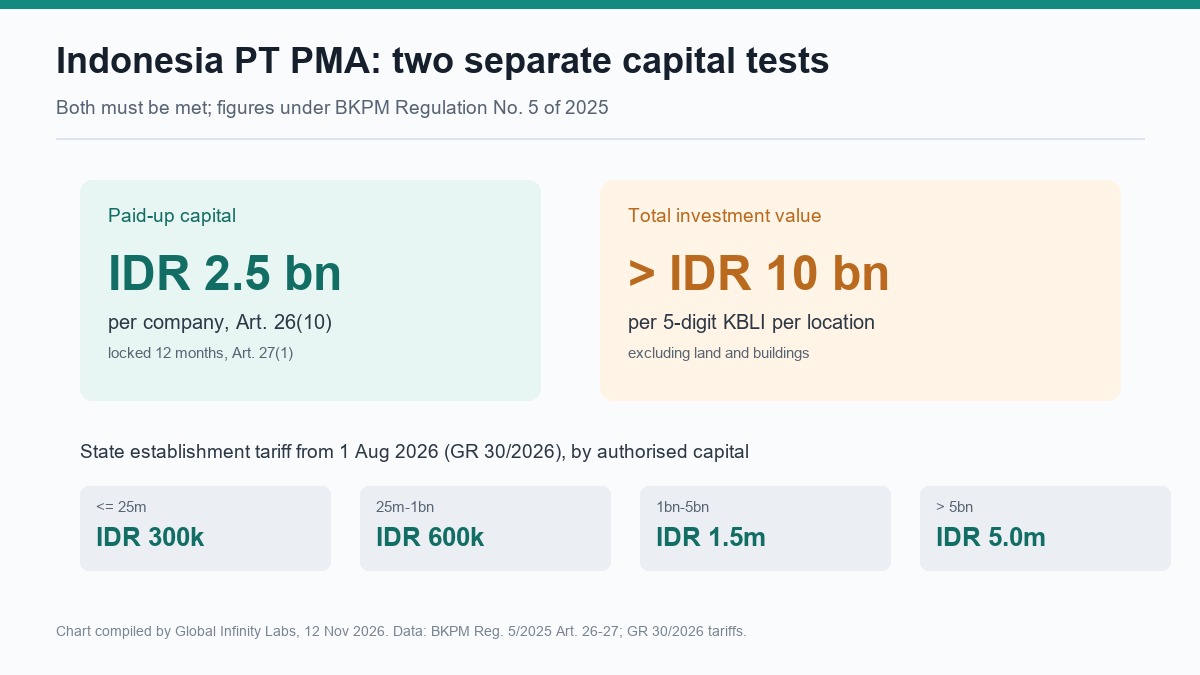
Under Pasal 26(10) of BKPM Regulation No. 5 of 2025, the pt pma minimum capital floor for a foreign-investment limited liability company in Indonesia is Rp2.500.000.000,00 per company, recorded in the official 698-page PDF as modal ditempatkan/disetor. Pasal 26(2) of the same regulation sets a separate investment-value test above Rp10,000,000,000, computed per five-digit KBLI and per project location with land and buildings excluded. Readers who collapse the pt pma minimum capital figure and the Rp10 billion investment plan into a single number will misread both tests. The two figures come from different paragraphs, answer different questions and carry different filing consequences, so a checklist that tracks only one of them is incomplete from the day the company is registered. A notary working from an older template will also find the paid-up number changed, which is why the article numbers matter as much as the amounts.
Who the capital rules apply to
Any shareholding by a foreign party makes the vehicle a PMA company, and Law No. 25 of 2007 Article 5(2) requires foreign investment to take the form of a limited liability company incorporated under Indonesian law with its domicile in Indonesia. Article 33 of the same law voids nominee shareholding arrangements, so a local name on the share register does not turn a foreign-funded entity into a domestic one. The pt pma minimum capital rules attach to the company form itself, independent of the nationality printed on a single document. That point is practical, since a nominee agreement gives no fallback when the capital filing is checked against the share register.
BKPM / Minister of Investment and Downstreaming Regulation No. 5 of 2025 was promulgated on 2025-10-02 and repealed BKPM Regulations No. 3, 4 and 5 of 2021 at the same time. Under the repealed BKPM 4/2021 the paid-up threshold was Rp10 billion, which is why older checklists still quote that figure. The 2025 text lowered the company-level paid-up floor to Rp2.500.000.000,00 while keeping the Rp10,000,000,000 investment-value test intact. A reader comparing an old engagement letter with a current one will therefore see two different paid-up numbers, and the operative one is the 2025 figure.
Law No. 25 of 2007 Article 5(2) also fixes the domicile requirement, which interacts with the project-location test in Pasal 26(2). The company is a single legal entity, yet the investment value is measured per five-digit KBLI and per location, so one company can carry several location-level calculations at once. This is a counting rule, leaving the company-level floor where it is.
Two separate capital tests
Pasal 26(2) and Pasal 26(9)(10) govern two independent figures. The investment-value test is above Rp10,000,000,000, excluding land and buildings for the business premises, measured per five-digit KBLI and per project location. The paid-up test is the pt pma minimum capital of Rp2.500.000.000,00 per company, unless a sector rule provides otherwise. One test sizes the project, the other sizes the company, and nothing in the text merges the two. The word per in Pasal 26(2) ties the threshold to each KBLI-location pair, so a single company can face the test more than once.
A concrete sum shows why the pt pma minimum capital figure cannot stand in for the investment plan. A company that deposits Rp2.5 billion in paid-up capital clears the company-level test. An investment plan totalling Rp9 billion still fails the above-Rp10 billion test, because Rp9 billion sits below the required threshold. Passing one gate says nothing about the other. The deposit is a balance-sheet item, while the investment plan is a project commitment, and the OSS filing asks for both.
Both tests must be satisfied on their own terms.
Pasal 26(3) and 26(5) change the counting unit by sector. Wholesale and construction use the first four KBLI digits, food and beverage uses the first two digits plus location, while real estate, accommodation, agriculture, plantation, livestock and aquaculture count land and buildings toward the investment value. The pt pma minimum capital floor itself stays at Rp2.500.000.000,00 per company across these variations, so the sector rules move the investment-value total and leave the paid-up floor where it is.
The obligation checklist
Compliance is a fixed sequence rather than a set of informal practices. A notarial deed establishes the company, the OSS system then issues the NIB, and the company sponsors the investor ITAS, with the KBLI checked in OSS for foreign-investment openness before filing. The pt pma minimum capital deposit, the pernyataan mandiri self-declaration in the OSS format of Attachment I, and the 12-month lock sit inside that sequence as documentary steps. Checking KBLI openness first avoids a filing that has to be rebuilt after the NIB is issued.
Pasal 27(1) locks paid-up capital in the company account for at least 12 months from the date of deposit, with exceptions limited to asset purchase, building construction and business operations.
Pasal 27(2) and 27(3) set the form of compliance: a self-declaration, or pernyataan mandiri, filed inside the OSS system in the format given in Attachment I. The declaration is a mandatory filing duty under the primary text, and the 12-month lock is a mandatory holding duty, so neither step is left to the discretion of the shareholder. Art. 286 adds a recurring duty, since the LKPM investment activity report is filed quarterly, due by the 15th of the following month for medium and large companies. JCSS Indonesia, reviewed on 2026-10-20, lists the quarterly filing dates as 15 April, 15 July, 15 October and 15 January. The LKPM obligation continues after incorporation and is separate from the one-time capital deposit.
Checking the pt pma minimum capital text
A secondary source checked on 4 November 2026, published on 5 November 2026 and updated on 10 November 2026, worked without the official text of BKPM Regulation No. 5 of 2025. Its article numbers came from Hukumonline dated 2025-07-18 and Prolegal, and the page carried a note to confirm details with a notary before any transfer. That describes retrieval conditions at the check date and leaves the content of the articles untouched.
This batch retrieved the 698-page official PDF directly from the BKPM regulation library and verified the Rp2.500.000.000,00 wording in Pasal 26(10) and the 12-month lock in Pasal 27(1) against the primary text. The pt pma minimum capital figure, the 12-month lock and the pernyataan mandiri form all carry primary-text support, and the self-declaration and the lock are obligations under that text. The official article numbers take precedence over the secondary citation, and the gap is one of access at the original check date.
The label Art. 26(9)(10) used in the main source and the Art. 26(10) label used here differ only in citation granularity, since paragraph (9) introduces the minimum-capital rule and paragraph (10) supplies the Rp2.500.000.000,00 amount. The kecuali ditentukan lain wording carries a second consequence: a sector-specific regulation may set a different amount, so the pt pma minimum capital floor operates as a default subject to override. A notary confirming a transfer should therefore read the sector rule alongside the general article.
Deadlines, filing windows and the 2026 fee bands
Three clocks govern a PMA file. The 12-month lock on paid-up capital runs from the deposit date. The LKPM report falls due by the 15th of the month after each quarter, with 15 April, 15 July, 15 October and 15 January as the filing dates. Government Regulation No. 30 of 2026 took effect on 2026-08-01 and changed incorporation fees to a banded scale based on authorized capital.
The four bands are Rp300,000 for authorized capital up to Rp25 million, Rp600,000 above Rp25 million to Rp1 billion, Rp1,500,000 above Rp1 billion to Rp5 billion, and Rp5,000,000 above Rp5 billion. Notary and professional coordination fees commonly run Rp20-60 million, and the 2026 corporate income tax rate is 22 percent. The bands are assessed on authorized capital, which is a figure the parties declare at incorporation.
The pt pma minimum capital amount is a deposit into the company. The incorporation fee is assessed on authorized capital as a separate figure, so the two are different line items on a setup budget under the pt pma minimum capital rules.
JCSS Indonesia, in the review dated 2026-10-20, records that Government Regulation No. 28 of 2025 replaced PP 5/2021 from 2025-06-05, that the KBLI 2025 transition under BPS Regulation No. 7 of 2025 needs no licence swap, and that foreign ownership caps follow Perpres 10/2021 and 49/2021. These are framework references and sit outside the capital calculation. The paid-up deposit does not set the ownership cap, and the ownership cap does not change the deposit floor.
Grey areas to confirm in writing
Three grey areas remain. First, a sector rule can set its own amount under kecuali ditentukan lain, so the pt pma minimum capital default must be checked against the KBLI-specific regulation before a transfer. Second, the counting unit shifts: five-digit KBLI for the general case, four digits for wholesale and construction, two digits plus location for food and beverage. Third, multiple project locations and multiple business lines are measured per location and per five-digit KBLI under Pasal 26(2), while real estate, accommodation, agriculture, plantation, livestock and aquaculture pull land and buildings into the investment value.
Where these units differ, the safe step is to obtain written capital and fee confirmations per line and to avoid assuming one consolidated figure. A file that records the article numbers, the deposit date, the self-declaration format, the LKPM dates and the applicable sector rule gives a notary and a company secretary a checklist they can verify line by line.
Sources
- Minister of Investment and Downstreaming / BKPM, “Regulation No. 5 of 2025 on Risk-Based Business Licensing and Investment Facilities through OSS” (2 October 2025, official text). https://jdih-storage.bkpm.go.id/jdih/jdih/2025Permeninvesthil005-.pdf
- Government of Indonesia, “Government Regulation No. 28 of 2025” (peraturan.go.id). https://peraturan.go.id/eng/pp-no-28-tahun-2025
- JCSS Indonesia, “Foreign Companies in Indonesia: Examples, Legal Forms and Requirements” (reviewed 20 October 2026). https://jcss.co.id/en/insights/foreign-companies-in-indonesia
- 3E Accounting Indonesia, “When a Local PT Is Not Enough: 7 Foreign-Ownership Scenarios That Require PT PMA Registration”. https://www.3ecpa.co.id/?p=46778
- AccessiaPass, “PMA Capital Rules 2026” (checked 4 November 2026). https://accessiapass.com/tl/blog/bolehkah-turis-asing-buka-usaha-di-bali-modal-pma-2026
This article was prepared by the expert team at Global Infinity Labs, drawing on insights and data provided through its MCP data services.
About Global Infinity Labs
Global Infinity Labs is an AI innovation company specializing in MCP data services.
Email: support@globalinfinitylabs.com
To share industry insights, report corrections, or submit story tips: editors@globalinfinitylabs.com or https://www.globalinfinitylabs.com/submit.