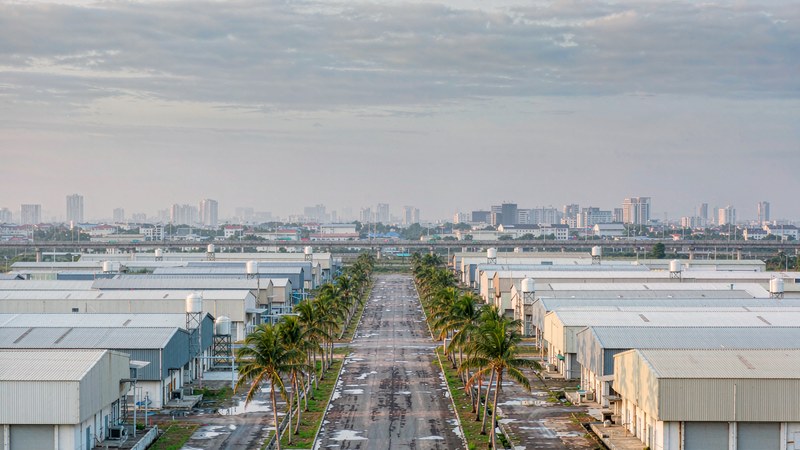
Greater Jakarta’s logistics occupancy reached roughly 97 percent in the third quarter of 2026, and the industrial estates around it are filling fast enough that land prices keep climbing. For a foreign manufacturer choosing where to put a factory in the corridor east of the capital, two of the oldest names on the map, Kota Jababeka and MM2100, still frame the decision better than any brochure. They represent two different scales, two different landlord models, and two different answers to the same question: what can a foreign investor actually own once the money is committed.
The market numbers behind the choice
CBRE’s third-quarter read of the market put logistics occupancy at approximately 97.0 percent, with industrial land absorption of around 59 hectares lifting overall occupancy across Greater Jakarta’s industrial estates to 91.6 percent. Occupiers concentrated in the established eastern corridors around Cikarang and Karawang, where CBRE credits mature infrastructure and utility reliability, increasingly a deciding factor for data center operators, for continued land price growth.
A parallel tracker published through Kontan shows the same market running hotter year on year. Leads Property recorded industrial land absorption of 130.6 hectares in the quarter, at a 92.3 percent sales rate, against roughly 26 hectares sold in the same quarter of 2025, and put the average industrial land price at IDR 3.37 million per square meter, up 0.51 percent quarter on quarter. Warehouse rents averaged IDR 77,000 per square meter per month, about 1.5 percent higher than six months earlier, with occupancy at 96.4 percent.
The two consultancies disagree on absorption, 59 hectares against 130.6, because they track different estates and apply different boundaries; both agree on direction. A market roundup across the major brokers puts the modern warehouse rent band at roughly IDR 77,600 to 81,800 per square meter per month for the 2026 market, and notes that none of the published figures states whether service charge or VAT is included. A 1,000 square meter unit therefore costs about IDR 78 million a month before extras, plus, typically, a three-month deposit.
What a foreign investor can actually hold
The ownership question trips up more first-time investors than the rent question. Indonesia’s Basic Agrarian Law of 1960 does not allow foreigners, personally, to own land. What a foreign investor does instead is incorporate a PT PMA, an Indonesian limited company with foreign shareholders, which can hold land rights in its own name. Sector access is governed by the Positive Investment List introduced by Presidential Regulation 10 of 2021 and amended later that year by Regulation 49: the default is openness, with 100 percent foreign ownership allowed unless a specific restriction applies.
The operative unit is not “manufacturing” in general. It is the KBLI code, the five-digit business classification that determines the foreign ownership ceiling and the licences attached to a specific activity. Checking the exact code before a site shortlist hardens is the cheapest step in the whole entry process, because the code, not the business plan, decides what is permitted.
On the land itself, a PT PMA holds Hak Guna Bangunan, a registered right to build, under Government Regulation 18 of 2021: an initial 30-year term, extendable by 20 years, with a further 30-year renewal. That is a right to build and use, transferable and mortgageable, not freehold ownership. For a factory with a 25-year asset life, the arithmetic is comfortable; for investors comparing quoted prices against freehold benchmarks elsewhere, it is the first reconciliation to make. One warning is worth stating plainly: using an Indonesian citizen as a nominal shareholder to get around the rules is illegal, and Indonesian courts will not enforce the private agreements behind such arrangements.
Jababeka: the city-scale route
Kota Jababeka is the larger of the two in every dimension. Its developer, PT Jababeka Tbk, was established in 1989 and in 1994 became the first industrial estate developer listed on the Indonesia Stock Exchange. The township covers some 5,600 hectares about 35 kilometers east of central Jakarta and is now home to more than 1,600 local and multinational companies from over 30 countries. Scale buys things smaller estates cannot self-provide: the estate operates its own dry port for import, export and domestic distribution, and runs a dedicated 130 megawatt power plant under an off-take contract with the state utility, which matters for any tenant whose process cannot tolerate grid fluctuation.
The trade-off is the one that comes with any mature city-scale estate: land inside it is priced accordingly, and new entrants compete for plots with an installed base of manufacturers that has been deepening for three decades. The developer has also pushed beyond the flagship site, into a special economic zone at Tanjung Lesung and a joint-venture park in Kendal, Central Java, which gives the same landlord a menu of locations at different cost points.
MM2100: the corridor route
MM2100 takes a different shape. Developed and managed by PT Megalopolis Manunggal Industrial Development, the estate has spent more than three decades building a compact community of over 300 companies drawn from eight countries, and has added 129 hectares of managed service area. Its location argument is precise: direct access to the Jakarta-Cikampek toll road through the Cibitung interchange, which puts port-bound cargo on the road without crossing city traffic.
What MMID offers instead of raw scale is managed density: integrated industrial water, wastewater treatment, gas and telecommunications; an in-house laboratory with a formal information management system for quality testing; a hotel for visiting teams; and its own vocational school and polytechnic that supply trained operators to tenants. For a mid-size manufacturer or a logistics operator whose priority is reliable utilities and workforce more than campus scale, that package answers a different brief than Jababeka’s.
The national context: more choice than the headlines suggest
The two estates sit inside a national inventory that is far from exhausted. The Ministry of Industry, presenting at an investment fair in November 2026, put the count at 181 industrial estates covering more than 110,000 hectares, hosting over 12,000 companies and about 2.3 million workers, with average land utilization of roughly 52 percent. National utilization of 52 percent against corridor occupancy above 90 percent is the central tension of the market: the established corridors are tight and repricing, while substantial developed land elsewhere in the inventory is still available at lower cost but with thinner surrounding ecosystems.
That gap is an opportunity rather than a warning, provided the decision is made on infrastructure evidence rather than price alone. The government has been tightening the supporting framework too, with simplified local content certification, tax holidays, super deductions for research and training, and import duty exemptions for capital goods.
A short checklist before signing
The entry route, in condensed form: confirm the KBLI code and its ownership ceiling before the site shortlist; run the HGB arithmetic, 30 plus 20 plus 30, against the project’s asset life; price the rent quote against what it excludes, since broker averages do not state whether service charge or VAT is inside the number; and match the estate to the load profile, because the data center demand CBRE describes is repricing plots with strong utilities and leaving others comparatively cheap. Both benchmark estates reward a site visit with specific questions: metered power guarantees at Jababeka, interchange access times at MM2100, and, in both cases, the current wait for a ready-to-build plot in the corridor that fits.
Sources
- JakartaWeekly 🔗, “Logistics Occupancy Reaches 97% in Greater Jakarta” (28 October 2026): CBRE Indonesia Q3 2026 press release coverage, with logistics occupancy at about 97.0 percent, industrial land absorption of around 59 hectares, industrial estate occupancy at 91.6 percent, and corridor concentration in Cikarang and Karawang.
- CBRE Indonesia 🔗, “Jakarta Property Market Update Q3 2026”: official report page confirming industrial and logistics as top-performing sectors on high occupancy and infrastructure quality.
- Kontan via Samudera Indonesia Research 🔗, “Q3 2026 Greater Jakarta Industrial Land and Warehousing Market Developments” (3 November 2026): Leads Property absorption of 130.6 hectares at a 92.3 percent sales rate, average land price of IDR 3.37 million per square meter, warehouse rent of IDR 77,000 per square meter per month, and occupancy of 96.4 percent.
- RRI 🔗, “Indonesia Showcases 181 Industrial Zones to Chinese Investors” (11 November 2026): Ministry of Industry figures of 181 estates over 110,000 hectares, more than 12,000 companies, 2.3 million workers, and average land utilization of about 52 percent.
- PT Jababeka Tbk 🔗, “About Us” (official corporate site): 5,600-hectare flagship township, more than 1,600 companies from over 30 countries, own dry port, dedicated 130 MW power plant under a PLN off-take contract, and first estate listing in 1994.
- MM2100 Industrial Town (official estate site, PT Megalopolis Manunggal Industrial Development) 🔗: more than 300 companies from eight countries, 129 hectares of managed service area, Cibitung interchange access to the Jakarta-Cikampek toll road, and on-site vocational and polytechnic schools.
- InvestinAsia 🔗, “What Is a PT PMA? Indonesia’s Foreign-Owned Company Explained for Investors” (2026): Positive Investment List access under Presidential Regulation 10 of 2021, HGB land rights of 30 years plus 20 plus 30, and the legal status of nominee shareholder arrangements.
- Yard Zeal 🔗, “Warehouse Rental Rates in Indonesia: 2026 Prices per m2”: broker roundup putting the modern warehouse band at IDR 77,600 to 81,800 per square meter per month for 2026 across Colliers, CBRE and Cushman & Wakefield figures.
This article was prepared by the expert team at Global Infinity Labs, drawing on insights and data provided through its MCP data services.
About Global Infinity Labs
Global Infinity Labs is an AI innovation company specializing in MCP data services.
Email: support@globalinfinitylabs.com
To share industry insights, report corrections, or submit story tips: editors@globalinfinitylabs.com or https://www.globalinfinitylabs.com/submit.